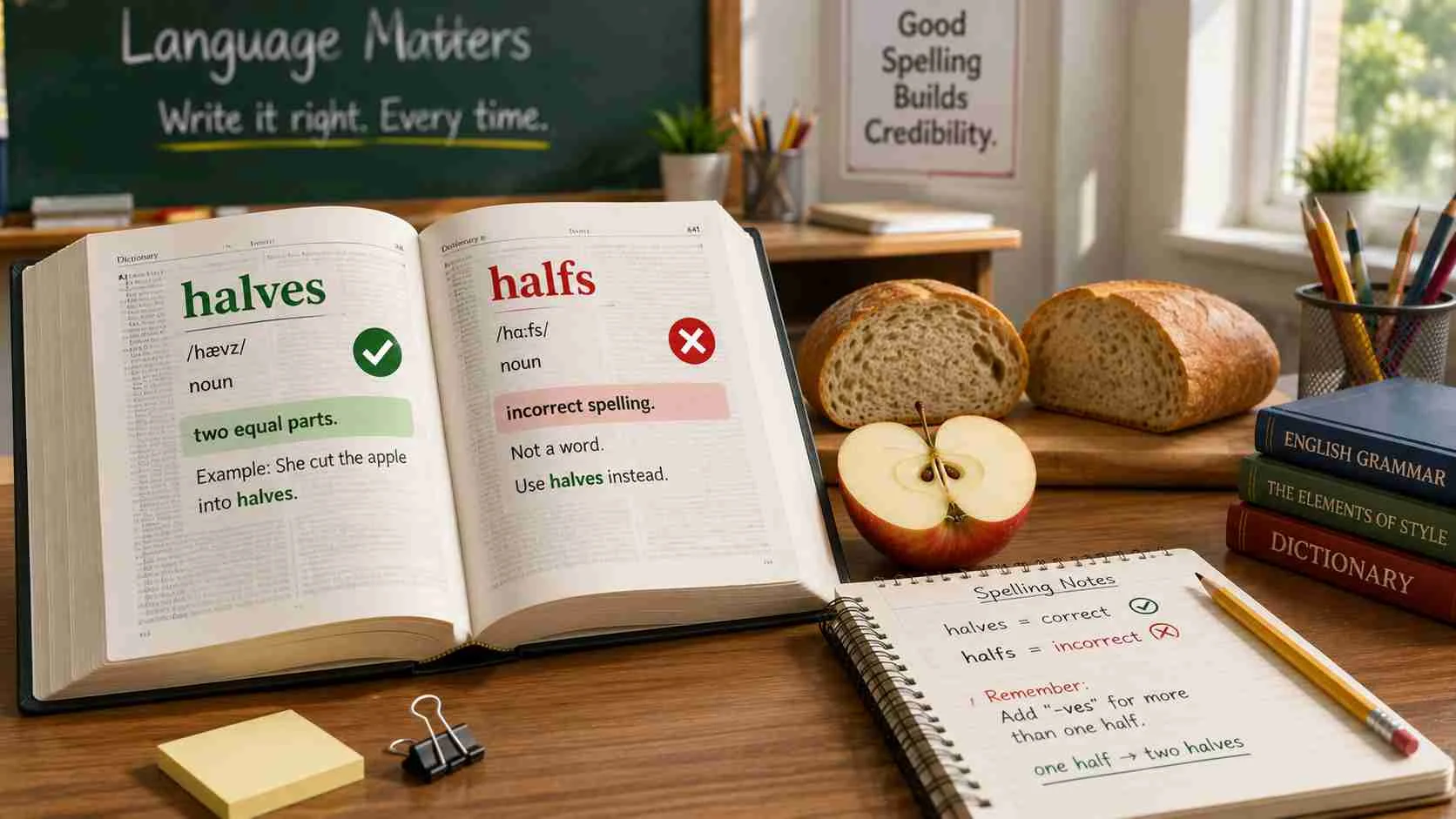
Halves or halfs often confuses English learners because both appear to follow common plural spelling patterns. The correct plural form of half is halves, while halfs is considered incorrect in standard English. This change follows a spelling rule where some nouns ending in f change to ves when made plural.
If you’ve ever paused while writing halves or halfs, you’re not alone. English has plenty of spelling patterns that seem predictable until they suddenly are not. The word half refers to one of two equal parts of something. Many people naturally assume its plural should be halfs, just as roof becomes roofs.
However, standard English uses halves as the only accepted plural form. Choosing the wrong spelling can make academic papers, workplace documents, and online writing appear less polished. Understanding why this happens makes it much easier to remember the correct form every time.
Halves or Halfs | What’s the Difference?
At first glance, both words may seem reasonable, but only one belongs in standard English.
Half is a noun that means one of two equal parts of a whole. Its accepted plural form is halves.
Halfs is a misspelling. It does not appear in standard dictionaries as the plural of half and should be avoided in formal and informal writing alike.
| Word | Part of Speech | Meaning | Correct Usage |
|---|---|---|---|
| Half | Noun | One of two equal parts | Yes |
| Halves | Plural noun | More than one half | Yes |
| Halfs | Incorrect spelling | Not accepted in standard English | No |
Mini Recap
The singular form is half.
The plural form is halves.
The spelling changes from f to ves instead of simply adding s.
Using halfs is considered a spelling mistake in modern English.
Halves or Halfs | What’s the Difference?
Many spelling questions involve vocabulary, but this one is mainly a matter of grammar and correct word formation.
English contains a group of nouns whose plural forms change their ending instead of simply adding s. The word half belongs to this category, just like knife becomes knives and wolf becomes wolves.
This means halves and halfs are not interchangeable.
In formal writing, academic papers, business communication, journalism, and published books, only halves is accepted.
Even in casual conversation or social media, careful writers use halves because it reflects standard English spelling.
Language learners sometimes create halfs because many English nouns simply add s to form the plural. While this reasoning makes sense, it does not match the accepted spelling rule for this particular word.
Using Halves Correctly
Since halves is the only correct plural, learning how it appears in real situations helps reinforce proper usage.
In everyday conversation, people often talk about dividing food, responsibilities, or time into equal parts.
Examples
She cut the apple into two halves.
The cake was divided into four equal halves for the demonstration.
The twins each received one of the two halves of the prize.
Workplace Example
The manager split the project into two halves so each team could finish its work before the deadline.
Academic Example
The science teacher compared the two halves of the human brain during today’s lesson.
Technology Example
The image processing software automatically joined the two halves of the scanned document into one complete file.
Usage Recap
Whenever you need the plural of half, always write halves. This spelling is accepted in dictionaries, educational materials, newspapers, and professional writing around the world.
Understanding Why Halfs Is Incorrect
Because halfs looks logical, many writers accidentally use it. However, English spelling is influenced by history rather than pure consistency.
Words ending in f sometimes change to ves in the plural. The word half follows this traditional pattern.
Although English has exceptions such as roofs, chiefs, and beliefs, half is not one of them.
You may occasionally encounter halfs in online comments, informal posts, or typing errors, but it is not considered correct by modern dictionaries or grammar guides.
Workplace Example
Incorrect
The report was divided into two halfs.
Correct
The report was divided into two halves.
Academic Example
Incorrect
Students labeled the two halfs of the circle.
Correct
Students labeled the two halves of the circle.
Technology Example
Incorrect
The software stitched both halfs of the panorama together.
Correct
The software stitched both halves of the panorama together.
Usage Recap
If you see halfs, treat it as a spelling error rather than an accepted alternative. Replacing it with halves immediately improves the accuracy and professionalism of your writing.
When You Should NOT Use Halves or Halfs
Knowing what not to write is just as valuable as knowing the correct form.
Do not write halfs when referring to more than one half.
Do not assume every word ending in f follows the same plural rule.
And do not rely on spell check alone because some typing tools may miss contextual errors.
Do not copy incorrect spellings from social media or discussion forums.
Do not use halfs in academic essays or research papers.
And do not use halfs in business reports, presentations, or client communication.
Do not invent plural forms based only on pronunciation.
Do not ignore dictionary guidance when uncertain about spelling.
Common Mistakes and Decision Rules
| Correct Sentence | Incorrect Sentence | Explanation |
|---|---|---|
| The orange was cut into two halves. | The orange was cut into two halfs. | Halves is the correct plural. |
| Both halves of the map fit together perfectly. | Both halfs of the map fit together perfectly. | Standard English requires halves. |
| The students compared the two halves of the experiment. | The students compared the two halfs of the experiment. | Halfs is not accepted. |
| She folded the paper into equal halves. | She folded the paper into equal halfs. | Use the traditional plural form. |
| The software combined both halves of the image. | The software combined both halfs of the image. | Professional writing always uses halves. |
Decision Rule Box
If you mean one of two equal parts, use half.
If you mean more than one equal part, use halves.
Never use halfs, because it is not the accepted plural form in standard English.
Halves and Halfs in Modern Technology and AI Tools
Modern grammar checkers, search engines, and artificial intelligence writing assistants are trained on vast collections of edited English text. As a result, they recognize halves as the standard plural form of half and typically flag halfs as a spelling error.
If you type halfs into most word processors, you will usually see a spelling suggestion directing you to halves. AI writing tools also favor halves because it appears consistently in dictionaries, academic publications, newspapers, and professionally edited content.
Even though incorrect spellings occasionally appear on social media or online forums, they do not change the accepted standard. Writers who want clear and credible communication should always choose halves.
The History of the Word
The word half comes from Old English healf, meaning one of two equal parts. As English developed, several nouns ending in f changed their plural ending to ves. This historical spelling pattern gave us words such as calf and calves, leaf and leaves, wolf and wolves, and half and halves.
Over time, some English words stopped following this pattern. For example, roofs and chiefs simply add s. However, half retained its traditional plural, which is why halves remains the only correct spelling today.
Expert Insight
“Good spelling reflects more than memorization. It demonstrates an understanding of how English words have evolved over centuries. Recognizing established plural forms such as halves helps writers communicate with greater accuracy and confidence.”
Real World Case Studies
Case Study One | Academic Writing
A university writing center reviewed essays submitted by first year students and found that spelling mistakes involving irregular plurals appeared frequently. One common error was writing halfs instead of halves. After students completed a short grammar lesson on irregular plurals, these mistakes dropped significantly in later assignments. The improvement also contributed to stronger overall writing scores.
Case Study Two | Business Communication
A marketing agency noticed recurring spelling errors in internal reports before client presentations. Among them was the repeated use of halfs in project documentation. After introducing a company style guide and automated proofreading tools, spelling accuracy improved, editing time decreased, and client facing documents became more professional.
Error Prevention Checklist
Use this quick checklist whenever you write about more than one half.
Always use halves as the plural of half.
Remember that half changes f to ves.
Check important documents with a trusted dictionary or grammar checker.
Read your writing aloud to catch unusual spellings.
Remember similar word pairs such as leaf and leaves.
Proofread business emails before sending them.
Review academic assignments carefully before submission.
Learn irregular plurals instead of guessing them.
Never use halfs when:
Writing school assignments.
Preparing business reports.
Publishing articles or blog posts.
Writing professional emails.
Creating website content.
Producing academic research.
Related Grammar Confusions You Should Master
If you found this spelling question helpful, these commonly confused words are also worth learning.
Woman or Women
Learn when to use the singular and plural forms correctly.
Leaf or Leaves
Understand another common f to ves plural change.
Wolf or Wolves
Discover why some nouns change their endings while others do not.
Knife or Knives
Master another frequently used irregular plural.
Shelf or Shelves
Avoid one of the most common spelling mistakes involving plural nouns.
Loaf or Loaves
See how traditional English spelling patterns continue to influence modern writing.
Life or Lives
Understand the difference between a noun and its irregular plural.
Its or It’s
Learn the difference between possession and contraction.
Affect or Effect
Avoid one of the most misunderstood word pairs in English.
Then or Than
Improve sentence accuracy by choosing the correct comparison word.
FAQs
Is halves or halfs correct in English?
Only halves is correct. It is the standard plural form of half in British English, American English, Canadian English, Australian English, and other major varieties of English. Halfs is a spelling mistake and should not be used in formal or informal writing.
Why is the plural of half written as halves instead of halfs?
The word half follows an older English spelling rule in which some nouns ending in f change to ves when they become plural. Although not every word ending in f follows this pattern, half has retained this historical form.
Can I ever use halfs in professional writing?
No. Professional editors, publishers, educators, and dictionaries recognize only halves. Using halfs may make your writing appear less accurate and less credible.
Is halfs accepted in any English dictionary?
Standard dictionaries list halves as the plural of half. While halfs may occasionally appear in discussions about common misspellings, it is not accepted as the standard plural form.
How can I remember the correct spelling of halves?
A useful memory trick is to group half with words such as leaf, knife, and wolf. Their plurals become leaves, knives, and wolves, making halves much easier to remember.
Do grammar checkers recognize halfs as incorrect?
Yes. Most grammar and spelling tools identify halfs as an error and recommend replacing it with halves. This includes many popular word processors and AI writing assistants.
Is halves used in both British and American English?
Yes. There is no regional difference in this case. Writers in both British and American English use halves as the correct plural form.
Why do some words ending in f take only s while half changes to ves?
English has developed through centuries of language change. Some words kept the traditional ves ending, while others gradually adopted a simple s. Because of this history, each irregular plural must be learned individually.
Can AI writing tools help me avoid this mistake?
Yes. Most AI writing assistants and grammar checking software are trained on standard English usage. They will usually recommend halves whenever halfs is entered.
Conclusion
Choosing between halves and halfs is actually quite simple once you understand the rule. The word half has only one accepted plural form, which is halves. Although halfs may seem logical because many English nouns simply add s, it is not recognized in standard English.
Remember that half belongs to a group of irregular nouns that change f to ves in the plural. You are writing an academic essay, a workplace report, an email, or online content, using halves demonstrates accuracy and professionalism.
By learning the pattern and reviewing similar irregular plurals, you can avoid this common spelling mistake with confidence.
Discover More Related Articles:
- Sergeant or Sargeant | The Mistake Even Native Speakers Make In 2026
- Since or Sense | The Mistake That Quietly Hurts Your Writing In 2026
- Lended or Lent | Which Word Is Correct & When Should You Use It In 2026