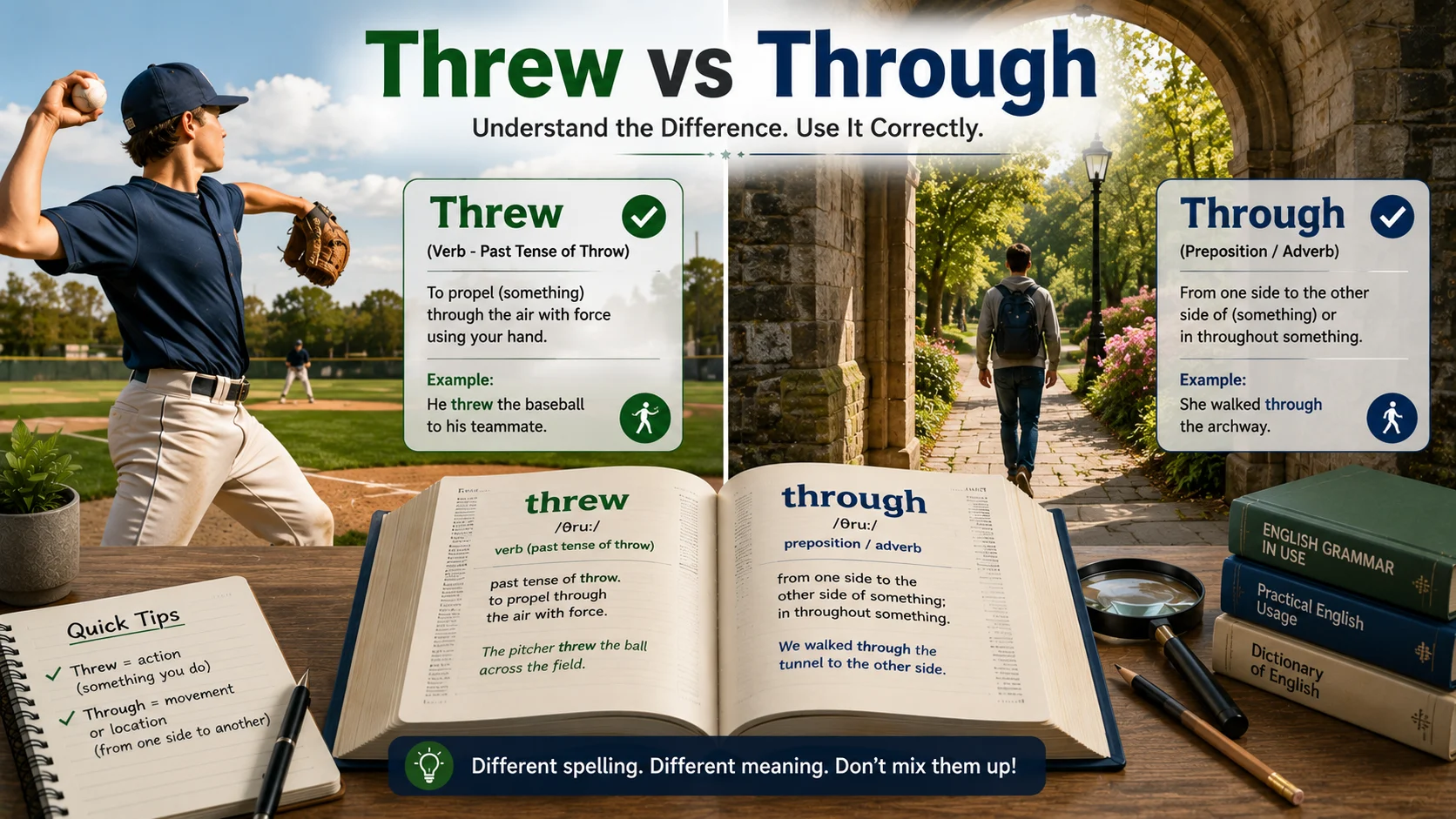
Threw or through is a common word confusion because the two words sound almost identical but have completely different meanings and functions. Threw is the past tense of the verb throw, meaning to send something through the air. Through is most often a preposition or adverb that means moving from one side to another, completing something, or continuing until the end.
If you’ve ever paused while writing threw or through, you’re not alone. These words are perfect examples of English homophones, which are words that sound alike but have different spellings and meanings.
Choosing the wrong one can change the meaning of a sentence, create confusion, and make professional, academic, or everyday writing appear careless. Fortunately, once you understand how each word works, remembering the difference becomes much easier.
Threw vs Through | What’s the Difference?
Although threw and through share the same pronunciation in most English accents, they belong to different parts of speech and serve entirely different purposes.
Threw is the simple past tense of the verb throw. It describes the action of tossing, launching, or sending something through the air.
Through is usually a preposition, although it can also function as an adverb or adjective depending on the sentence. It describes movement from one side to another, completion of a process, or passing within something.
| Feature | Threw | Through |
|---|---|---|
| Part of speech | Verb, past tense of throw | Preposition, adverb, sometimes adjective |
| Meaning | Tossed or launched something | From one side to another, completed, continuing until the end |
| Action word | Yes | No |
| Refers to movement | Throwing an object | Passing across or inside something |
| Common examples | Threw the ball, threw the keys | Walked through the park, worked through the night |
| Can replace the other? | No | No |
After looking at the comparison, one simple idea stands out. Threw always describes an action that already happened, while through usually describes direction, position, progress, or completion. Even though they sound alike, they are never interchangeable. Paying attention to the role each word plays in a sentence is the easiest way to choose the correct spelling.
Is Threw vs Through a Grammar, Vocabulary or Usage Issue?
The confusion between threw and through is mainly a usage and vocabulary issue, not a grammar mistake.
English contains many homophones that sound identical but carry unrelated meanings. Since our ears cannot distinguish the spelling, writers often rely on memory rather than understanding. That is why these words frequently appear as spelling errors in emails, essays, text messages, and even business documents.
From a grammatical perspective, each word has a clearly defined role.
Threw functions only as a verb because it expresses an action that happened in the past.
Through usually functions as a preposition by showing movement, direction, location, or completion. In some sentences it can also work as an adverb.
The two words are never interchangeable because they belong to different grammatical categories.
In formal writing, such as academic papers, legal documents, business reports, or professional communication, using the correct word is essential. A sentence containing the wrong spelling may distract readers and reduce credibility.
Casual conversations, text messages, and social media posts often contain this mistake because spell checkers may not catch it. Since both words are correctly spelled English words, software cannot always determine which one the writer intended.
Understanding the meaning rather than memorizing the spelling is the best long term solution.
How to Use Threw Correctly
The word threw is the simple past tense of the verb throw. Whenever you are talking about tossing, hurling, casting, or sending something through the air in the past, threw is the correct choice.
Think of it as describing a completed physical or figurative action. Someone threw a ball, threw away old papers, threw a surprise party, or threw their support behind a project. In every case, the action has already happened.
Workplace Examples
In professional settings, threw often appears when discussing completed actions or events.
- The manager threw the proposal onto the conference table before the meeting started.
- The marketing team threw all its effort into the new campaign.
- The supervisor threw out several outdated procedures during the review.
These examples show both literal and figurative uses of the word.
Academic Examples
Students and teachers also use threw in classroom writing.
- The student threw the paper airplane after the lesson ended.
- During the experiment, the researcher threw the sample into the testing chamber.
- The athlete threw the javelin farther than every other competitor.
Notice that every sentence refers to an action completed in the past.
Technology Examples
Although technology writing focuses on digital activities, threw still appears in everyday communication.
- The user accidentally threw the damaged phone into the recycling bin.
- The technician threw away the faulty cable after replacing it.
- The child became frustrated and threw the game controller onto the couch.
Even in technology related contexts, the word always refers to a past action.
Common Expressions Using Threw
English also includes several idiomatic expressions with threw.
| Expression | Meaning |
|---|---|
| Threw away | Discarded something |
| Threw out | Removed or rejected something |
| Threw a party | Organized an event |
| Threw a fit | Reacted with anger or frustration |
| Threw support behind | Publicly backed someone or something |
| Threw off | Caused confusion or interruption |
Learning these expressions helps you recognize the word naturally in everyday English.
Usage Recap
Whenever you are describing a completed act of throwing, tossing, discarding, launching, or even supporting something in a figurative sense, threw is the correct word. If the sentence answers the question What action happened in the past?, you almost certainly need threw.
How to Use Through Correctly
Unlike threw, the word through does not describe the act of throwing something. Instead, it usually shows movement, direction, completion, or progress. It is most commonly used as a preposition, although it can also function as an adverb or adjective in certain contexts.
You use through when something passes from one side to another, continues until the end of a period, or moves within a place or process.
For example, someone can walk through a tunnel, read through a report, work through a difficult problem, or stay awake through the night. In each case, the word connects ideas about movement or completion rather than describing an action of throwing.
Workplace Examples
The word through appears frequently in professional communication because many business tasks involve processes and completion.
- The team worked through the weekend to finish the project.
- Please read through the proposal before the meeting.
- We moved through each stage of the hiring process successfully.
These examples show how through often refers to progress or moving from one stage to another.
Academic Examples
Students and educators regularly use through in writing and classroom discussions.
- She carefully read through the entire textbook before the exam.
- The teacher guided the class through each step of the experiment.
- We learned about European history through original documents.
Here, through expresses completion, guidance, or the method by which something happens.
Technology Examples
Technology writing also relies heavily on through.
- Users can access their files through the mobile application.
- The software sends encrypted data through a secure connection.
- The update was completed through an automatic installation process.
In technology related contexts, through often indicates the method, route, or system used to complete a task.
Common Expressions Using Through
| Expression | Meaning |
|---|---|
| Go through | Experience or examine something |
| Read through | Read completely |
| Work through | Solve or complete step by step |
| Get through | Finish or successfully complete |
| Break through | Overcome a barrier |
| Come through | Succeed or deliver as expected |
| Pass through | Move from one side to another |
| Through and through | Completely or entirely |
Understanding these common phrases makes it much easier to recognize the correct use of through in everyday English.
Usage Recap
Choose through whenever your sentence refers to movement, direction, completion, a method, or progress. If the idea involves passing across something, finishing a process, or continuing until the end, through is the correct choice.
When You Should NOT Use Threw or Through
Although these words sound alike, using the wrong one changes the meaning of a sentence completely. Here are some of the most common situations where writers make mistakes.
- Do not use threw when talking about moving from one place to another. Incorrect: We walked threw the forest. Correct: We walked through the forest.
- Do not use through when describing the past action of tossing an object. Incorrect: She through the ball to her brother. Correct: She threw the ball to her brother.
- Do not use threw to describe completing a task. Incorrect: I threw the report before submitting it. Correct: I read through the report before submitting it.
- Do not replace through with threw when discussing a process. Incorrect: The application went threw several reviews. Correct: The application went through several reviews.
- Do not assume pronunciation determines spelling. Both words sound almost identical, but their meanings are completely unrelated.
- Do not rely only on spell check. Since both are correctly spelled English words, spelling software may not detect the mistake.
- Do not memorize them only by appearance. Instead, remember the meaning first. Ask the sentence describes an action of throwing or movement and completion.
- Do not use one as a shortcut for the other in professional writing. Business documents, academic assignments, and published content require the correct spelling to maintain clarity and credibility.
Common Mistakes and Decision Rules
| Correct Sentence | Incorrect Sentence | Explanation |
|---|---|---|
| She threw the keys onto the table. | She through the keys onto the table. | Threw is the past tense of throw. |
| We walked through the museum. | We walked threw the museum. | Through shows movement from one side to another. |
| He threw the football across the field. | He through the football across the field. | The sentence describes a completed action. |
| Please read through the instructions carefully. | Please read threw the instructions carefully. | Through means completely or from beginning to end. |
| The package passed through customs. | The package passed threw customs. | The sentence describes movement through a process. |
| The child threw the toy into the basket. | The child through the toy into the basket. | Only threw works as the past tense verb. |
| We worked through several difficult problems. | We worked threw several difficult problems. | Through refers to completing a series of tasks. |
| She threw away the old notebook. | She through away the old notebook. | The phrasal verb is threw away. |
Decision Rule Box
| If your sentence means | Use |
|---|---|
| The past action of tossing, launching, or discarding something | Threw |
| Moving from one side to another | Through |
| Completing a process or task | Through |
| Reading from beginning to end | Through |
| A finished act of throwing | Threw |
Threw and Through in Modern Technology and AI Tools
Modern grammar checkers and AI writing assistants have become much better at identifying homophone errors, but they are not perfect. Because threw and through are both correctly spelled words, software may overlook the mistake if the surrounding sentence is unclear.
For example, an AI tool can easily recognize that She threw the ball is correct because the verb fits the sentence naturally. However, a short sentence with limited context may confuse automated systems. That is why human proofreading remains essential, especially for academic papers, business reports, website content, and professional emails.
The best writing combines intelligent editing tools with careful reading. Understanding the meaning of each word is still the most reliable way to avoid mistakes.
The Etymology of Threw and Through
Although these words sound alike today, they come from different historical roots.
Threw developed from the Old English verb throwan, meaning to twist, cast, or hurl. Over centuries, the verb evolved into the modern form throw, with threw becoming its simple past tense.
Through comes from the Old English word thurh, which meant passing from one side to another or moving across an opening. Its meaning has remained remarkably consistent throughout the history of English.
Their separate origins explain why they share pronunciation but not meaning or grammatical function.
Good writing is not about choosing words that sound right. It is about choosing words that express the exact meaning you intend.
Professional English Language Editor
Case Study One | Improving Student Writing Accuracy
A secondary school English department noticed that homophone errors appeared in nearly one out of every five essays. Teachers introduced short weekly lessons focusing on commonly confused words, including threw and through.
After one academic term, spelling related meaning errors dropped significantly, and students showed greater confidence in proofreading their own work before submission.
Case Study Two | Enhancing Business Communication
A customer support company reviewed hundreds of outgoing emails and found repeated homophone mistakes that occasionally confused clients. After providing employees with a concise grammar reference guide and editing checklist, the company observed clearer communication, fewer customer clarification requests, and faster response times.
The improvement demonstrated that mastering small language details can produce measurable gains in professional communication.
Error Prevention Checklist
Use this quick checklist whenever you are unsure to write threw or through.
| Always use Threw when | Never use Threw when |
|---|---|
| You mean the past tense of throw. | You mean moving from one place to another. |
| Someone tossed or launched something. | You are describing a process or completion. |
| An object was discarded or thrown away. | You are talking about reading or working from beginning to end. |
| The action happened in the past. | You mean by means of or by way of something. |
| Always use Through when | Never use Through when |
|---|---|
| Something moves from one side to another. | You are describing the act of throwing. |
| You mean until the end of a period. | A person tossed an object. |
| A task or process is completed. | You need the past tense verb throw. |
| You describe a method or route. | The sentence requires an action verb. |
A quick way to remember the difference is to ask yourself one simple question. Is my sentence describing an action of throwing, or is it describing movement, completion, or direction? The answer almost always reveals the correct word.
Related Grammar Confusions You Should Master
Many English homophones create the same kind of confusion as threw and through. Learning these pairs will strengthen both your writing and proofreading skills.
| Common Confusion | Why It Causes Problems |
|---|---|
| Their or There or They’re | Similar pronunciation but different grammatical roles. |
| Your or You’re | Possessive adjective versus contraction. |
| Its or It’s | Possession versus shortened form of it is. |
| Then or Than | Time versus comparison. |
| To or Too or Two | Direction, excess, and number. |
| Affect or Effect | Verb versus noun in most contexts. |
| Lose or Loose | Verb versus adjective. |
| Than or Then | Frequently confused in comparisons. |
| Passed or Past | Verb versus noun, adjective, or preposition. |
| Accept or Except | Receive versus exclude. |
Mastering these commonly confused words will improve clarity, reduce editing time, and make your writing more professional.
FAQs
What is the difference between threw and through?
Threw is the past tense of throw, while through refers to movement, direction, completion, or passing from one side to another. Although they sound alike, they have different meanings and grammatical functions.
Is threw a verb or a preposition?
Threw is always a verb because it describes the completed action of throwing something. It never functions as a preposition.
Can through ever replace threw?
No. Through and threw are never interchangeable because one describes direction or completion, while the other describes a past action.
Why do people confuse threw and through?
People confuse them because they are homophones. They are pronounced almost the same, even though their spellings and meanings are completely different.
How can I remember to use threw or through?
Think about the meaning of your sentence. If someone tossed something, use threw. If something moved across, continued, or finished, use through.
Is using through instead of threw a grammar mistake?
It is primarily a usage and spelling mistake rather than a grammar error. The sentence structure may remain correct, but the meaning becomes incorrect.
Do grammar checkers catch threw and through mistakes?
Not always. Since both are correctly spelled English words, grammar tools may miss the error if they cannot determine the intended meaning from the sentence.
Which word is more common in everyday English?
Both words are common, but through appears more frequently because it is used in many situations involving movement, time, methods, and completion.
Conclusion
Understanding threw or through becomes much easier once you focus on meaning instead of pronunciation. Threw is always the past tense of throw, describing an action that has already happened. Through describes movement, direction, completion, or passing from one place or stage to another.
Because both words sound nearly identical, they are often confused in everyday writing. However, remembering their grammatical roles makes choosing the correct spelling straightforward. Whenever your sentence involves tossing or launching something, use threw. Whenever it involves moving across, finishing a process, or continuing until the end, use through.
With regular practice and careful proofreading, this common homophone mistake will soon become one you never make again.
Discover More Related Articles:
- Adress or Address | What Is the Difference & Which Spelling Is Correct In 2026
- Tased or Tazed | Which Spelling Do Dictionaries Accept In 2026
- Excell or Excel | Why This Common Typo Keeps Appearing In 2026