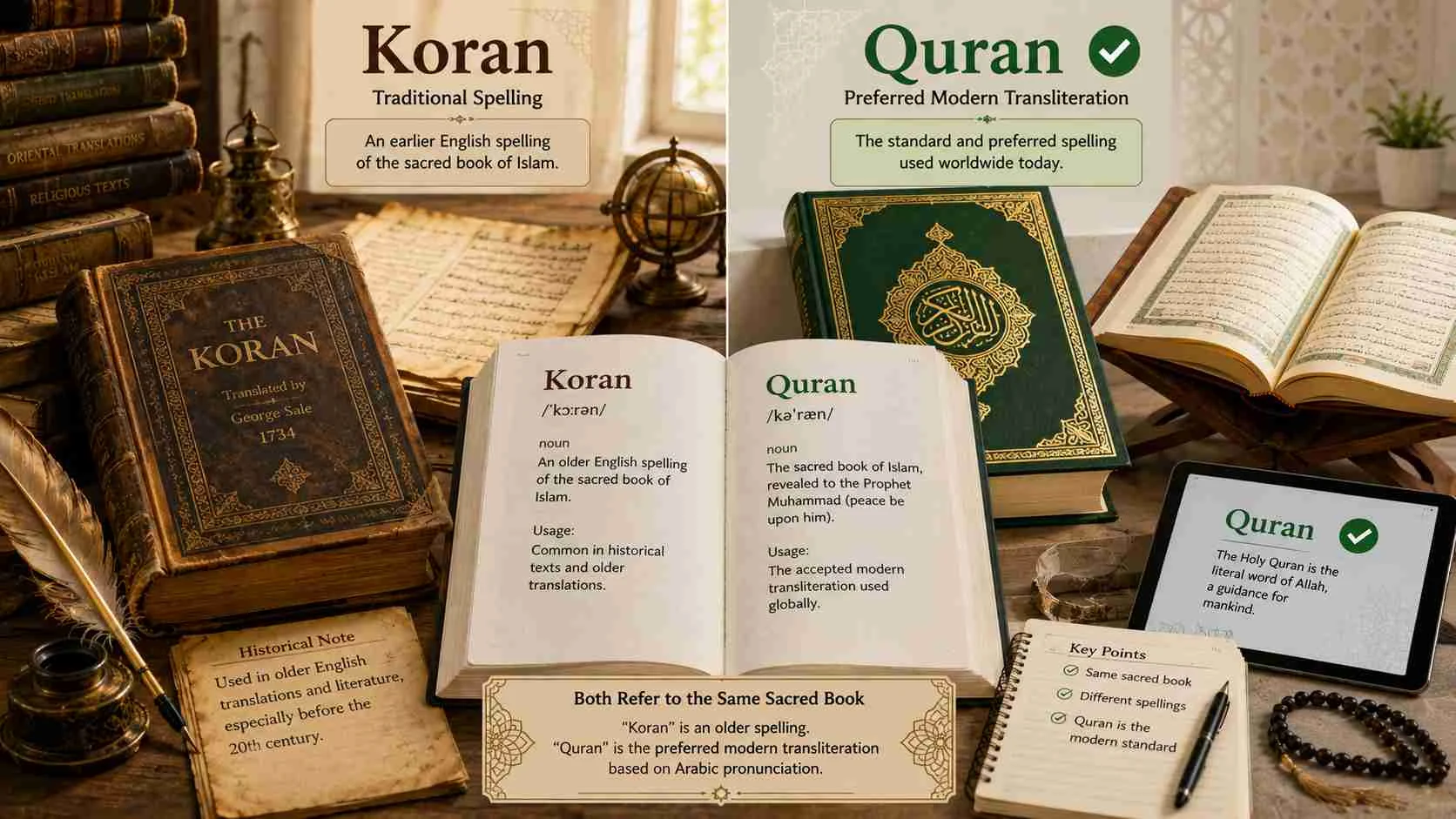
The terms Koran and Quran refer to the same sacred scripture of Islam. Quran is the modern and most widely accepted English transliteration of the original Arabic word القرآن, while Koran is an older English spelling that still appears in historical books and publications. Understanding the difference helps readers choose the most accurate and culturally appropriate form.
If you’ve ever searched for koran or quran, you’re not alone. These two spellings represent the same holy book, yet choosing the wrong one can create confusion in academic writing, journalism, publishing, and everyday communication.
While both words refer to Islam’s sacred text, one spelling is now widely preferred because it more closely reflects the original Arabic pronunciation. Knowing when to use each term will help you write with greater accuracy, respect, and confidence.
Koran or Quran | What’s the Difference?
Although both words refer to the same book, they differ in origin, usage, and modern acceptance.
| Feature | Quran | Koran |
|---|---|---|
| Part of speech | Proper noun | Proper noun |
| Meaning | The holy book of Islam | The holy book of Islam |
| Origin | Modern English transliteration of the Arabic word القرآن | Older English transliteration influenced by European languages |
| Current usage | Standard spelling used worldwide | Historical or traditional spelling |
| Preferred in academic writing | Yes | Rarely |
| Preferred by Muslim communities | Yes | Generally no |
| Common in modern media | Yes | Limited |
| Common in historical publications | Occasionally | Very common |
| Recommended for modern writing | Yes | Only when preserving historical titles or quotations |
| Pronunciation | Closely matches the original Arabic pronunciation | Anglicized pronunciation based on older transli |
Both spellings identify exactly the same religious text. The difference lies in how English writers have represented the Arabic word over time. Today, Quran has become the international standard because it more accurately reflects the Arabic pronunciation and is widely accepted by scholars, publishers, and Muslim communities.
Is Koran or Quran a Grammar, Vocabulary or Usage Issue?
This confusion is not a grammar mistake. Instead, it is a vocabulary and usage issue involving different English transliterations of the same Arabic word.
Unlike spelling mistakes such as their and there, Koran and Quran are both legitimate spellings. However, they are not equally appropriate in every context.
In formal writing, academic research, journalism, government publications, and educational materials, Quran is overwhelmingly preferred. It aligns with current linguistic standards and demonstrates respect for the original Arabic language.
The spelling Koran appears mainly in older English literature, historical translations, and archival documents. Modern readers may still encounter it in classic books or references published many decades ago.
In casual conversation, people often understand both spellings, but using Quran is generally considered more accurate and culturally sensitive.
Understanding the Word Quran
Quran is a proper noun referring to Islam’s holy scripture, believed by Muslims to be the literal word of God revealed to the Prophet Muhammad through the Angel Gabriel.
The spelling follows a modern transliteration approach that attempts to preserve the Arabic pronunciation more faithfully. Because Arabic sounds do not always have exact English equivalents, several spellings have existed throughout history. Nevertheless, Quran has become the accepted standard across most English speaking countries.
Workplace Example
A publishing editor updated the manuscript to use Quran consistently throughout the book to match the organization’s editorial style guide.
Academic Example
The university library added several new translations of the Quran to its collection for comparative religious studies.
Technology Example
Many digital search engines recognize Quran as the primary spelling when indexing religious texts and educational resources.
Usage Recap
Using Quran is the safest choice for nearly every modern situation. You are writing an article, preparing research, creating educational content, or communicating professionally, this spelling reflects current international standards.
Understanding the Word Koran
Koran is also a proper noun referring to the same sacred Islamic scripture. It represents an older English transliteration that became popular through European languages long before modern transliteration systems were widely adopted.
For centuries, many English translations and dictionaries used Koran because translators relied on French and Latin spelling conventions rather than directly representing Arabic pronunciation.
Today, this spelling is less common. Although it is not technically incorrect, many modern publishers prefer to avoid it because it no longer reflects accepted transliteration practices.
Workplace Example
A museum curator preserved the original spelling Koran when describing a nineteenth century exhibition catalogue.
Academic Example
Students studying the history of English translations often encounter the word Koran in older publications.
Technology Example
Digital archives frequently retain the original title Koran when scanning historical books rather than updating the spelling.
Usage Recap
Use Koran only when referring to historical documents, quoting older publications, discussing translation history, or preserving original titles. In almost every other situation, Quran is the better choice.
When You Should NOT Use Koran or Quran
Choosing the correct spelling depends on your purpose. Here are common situations where mistakes occur.
| Situation | Correct Choice |
|---|---|
| Writing a modern academic paper | Quran |
| Creating educational material | Quran |
| Publishing a news article | Quran |
| Referring to an old book title | Koran, if it is the original published title |
| Quoting a nineteenth century translation | Keep the original spelling used in the source |
| Updating modern website content | Quran |
| Writing interfaith educational resources | Quran |
| Discussing historical English translations | Either spelling, depending on the historical context |
| Following a modern style guide | Quran |
| Preserving archival or historical references | Koran |
The key principle is consistency. Once you choose the appropriate spelling for your context, use it consistently throughout your writing.
Common Mistakes and Their Corrections
| Correct Sentence | Incorrect Sentence | Explanation |
|---|---|---|
| The Quran is studied around the world. | The Koran is the preferred modern spelling. | Quran is the accepted modern English spelling used by most publishers and scholars. |
| Scholars translated the Quran into many languages. | Scholars translated the Quran and later renamed it Koran. | They are different English spellings of the same sacred book, not different works. |
| The original edition was titled The Koran. | The original edition was titled The Quran. | Preserve the original spelling when referring to historical book titles. |
| Modern textbooks usually write Quran. | Modern textbooks usually prefer Koran. | Most current educational resources use Quran as the standard spelling. |
| The museum displayed an old translation of the Koran. | The museum corrected every historical title to Quran. | Historical titles should remain unchanged to maintain accuracy. |
| Most universities recommend using Quran in research papers. | Most universities recommend using Koran in research papers. | Academic style guides generally prefer Quran today. |
| The article consistently uses Quran throughout. | The article switches between Quran and Koran without reason. | Consistency is important unless discussing historical sources or quotations. |
Decision Rule Box
If you mean the modern standard English spelling of Islam’s holy book, use Quran.
If you are quoting or referring to an older historical title or translation that originally used Koran, preserve the spelling Koran.
Koran or Quran in Modern Technology and AI Tools
Modern technology has largely standardized the spelling Quran. Search engines, translation software, digital libraries, educational platforms, and artificial intelligence writing assistants overwhelmingly recognize Quran as the preferred form.
That said, advanced search systems also recognize Koran as an alternative spelling. This means searches for either word usually return information about the same sacred text. However, content optimized for modern readers and search engines generally performs better when it consistently uses Quran.
Etymology of Quran and Koran
The word Quran comes from the Arabic word القرآن (Al Qur’an), which means the recitation or that which is recited. It is derived from the Arabic root Qara’a, meaning to read or to recite. This reflects the Islamic belief that the scripture was revealed orally to the Prophet Muhammad before being compiled into written form.
The spelling Koran developed centuries ago when European scholars transliterated Arabic words through languages such as French and Latin. Because Arabic contains sounds that do not exist in English, early translators chose the letter K to represent the first consonant. As linguistic standards evolved and direct Arabic transliteration became more common, Quran gradually replaced Koran in modern English.
Today, most dictionaries, universities, publishers, and international organizations recommend Quran because it more closely represents the original Arabic pronunciation.
Expert Insight
“Language changes as our understanding of other cultures improves. Choosing transliterations that reflect the original language more accurately helps readers communicate with greater precision and respect.”
This principle explains why Quran has become the preferred spelling across academic, educational, and professional writing.
Real World Case Studies
Case Study One | University Style Guide Update
A major university reviewed its religious studies materials after discovering that different departments used both Koran and Quran. Faculty members agreed to standardize all future publications using Quran, except when quoting historical texts.
Within one academic year, students reported fewer inconsistencies in research papers, and library catalog searches became more accurate because every new resource followed the same convention.
Case Study Two | Digital Publishing Improvement
An educational website specializing in world religions updated more than one hundred articles that used Koran as the default spelling. The editorial team replaced it with Quran while preserving historical spellings inside quotations and book titles.
The update improved consistency across the website and better matched the terminology readers expected when searching for information about Islam.
Error Prevention Checklist
Use this quick checklist whenever you write about Islam’s holy book.
☑ Always use Quran in modern articles, academic papers, educational resources, and professional communication.
☑ Use Koran only when quoting historical publications or preserving the original title of an older work.
☑ Keep your spelling consistent throughout the document.
☑ Remember that both spellings refer to the same sacred text.
☑ Follow the style guide required by your school, employer, or publisher.
☑ Avoid switching between spellings without a historical reason.
☑ Respect original book titles when citing historical sources.
☑ Choose Quran whenever no specific style guide requires otherwise.
FAQs
Is Quran the correct spelling or is Koran also correct?
Both spellings are correct because they refer to the same holy book of Islam. However, Quran is the modern and widely accepted English transliteration. Koran is an older spelling that mainly appears in historical books, older translations, and archival references.
Why do some books use the spelling Koran instead of Quran?
Many older English books were translated through French or Latin traditions before standardized Arabic transliteration became common. As a result, Koran appeared in numerous historical publications. Modern publishers generally prefer Quran because it more closely matches the Arabic pronunciation.
Do Quran and Koran refer to different books?
No. Both words refer to exactly the same sacred scripture of Islam. The only difference is the English spelling used by different writers and publishers over time.
Which spelling should students use in academic writing?
Most universities, academic journals, and educational publishers recommend using Quran. Unless your instructor or citation style specifically requires otherwise, this is the preferred spelling for research papers and assignments.
Should journalists use Quran or Koran?
Most modern news organizations use Quran in accordance with contemporary editorial standards. Some older publications may still contain Koran, particularly in archived material.
Is Koran considered incorrect today?
Not entirely. Koran is still recognized as a valid historical spelling. However, it is no longer the preferred choice in most modern writing because Quran has become the international standard.
Why is Quran the preferred modern spelling?
The spelling Quran better represents the pronunciation of the original Arabic word القرآن and follows current transliteration practices adopted by scholars and publishers around the world.
Can I use both spellings in the same article?
It is generally best to remain consistent. Use Quran throughout modern writing. Use Koran only when quoting historical works or referring to original titles that were published with that spelling.
Do search engines recognize both Quran and Koran?
Yes. Modern search engines understand that both spellings refer to the same topic. However, Quran aligns more closely with current search trends and user expectations.
Which spelling do Muslim communities usually prefer?
Most Muslim communities, Islamic organizations, and contemporary scholars prefer Quran because it reflects the original Arabic word more accurately and is the accepted modern English transliteration.
Conclusion
The debate over koran or quran is not about different books but about different English spellings of the same Arabic title. Although Koran has a long history in English, Quran is now the preferred spelling across modern journalism, education, publishing, and academic research because it more accurately reflects the original Arabic pronunciation.
If you are writing for today’s audience, choosing Quran is almost always the best decision. Reserve Koran for historical references, quotations, or older book titles where preserving the original spelling is important. Understanding this distinction ensures your writing remains accurate, respectful, and consistent.
Discover More Related Articles:
- Protestor or Protester | The Spelling Debate You Didn’t Know About In 2026
- Halves or Halfs | The Grammar Trick You’ll Never Forget In 2026
- Plushy or Plushie | Why Everyone Says It Differently In 2026