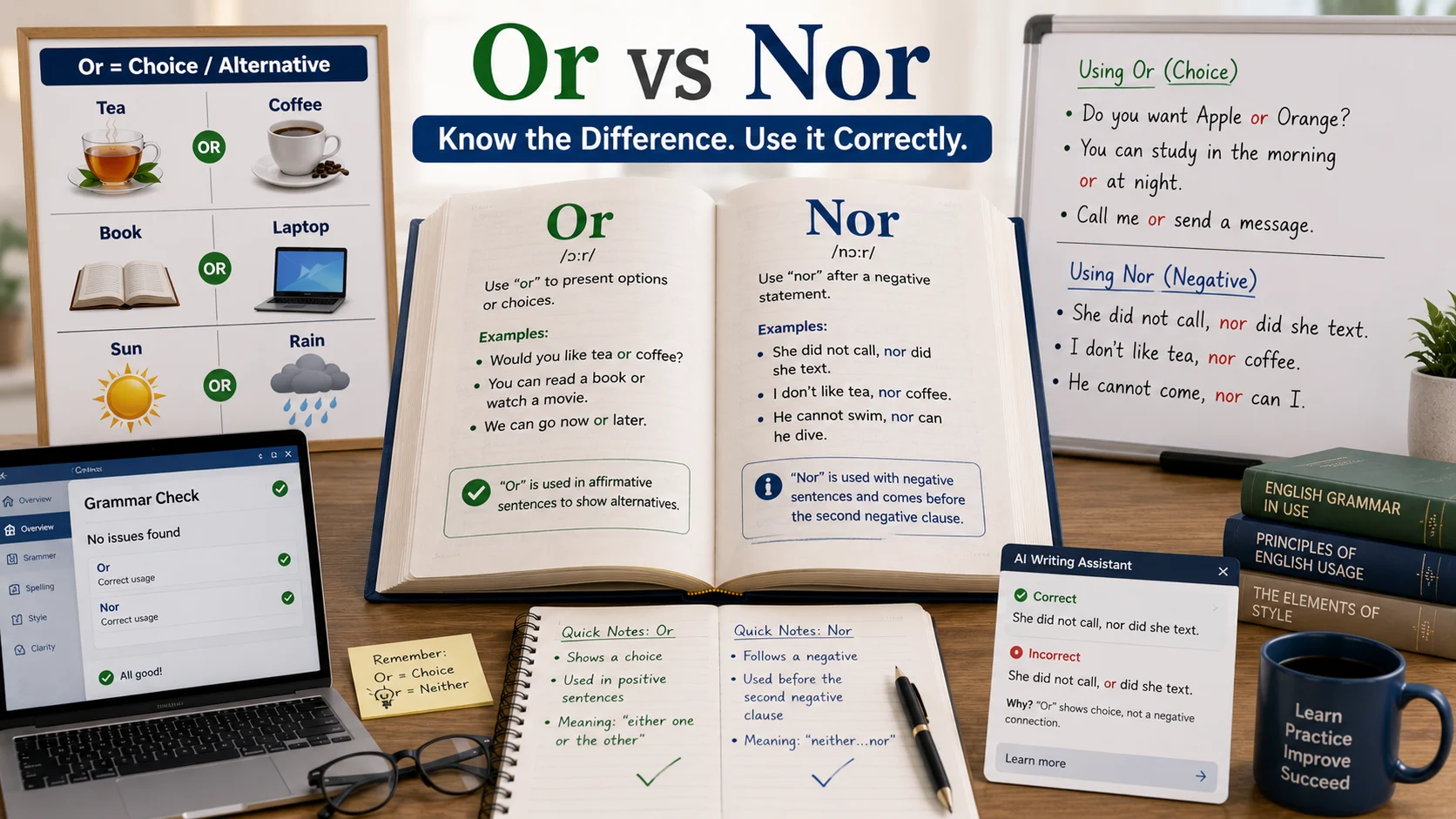
Or vs nor can confuse even experienced English speakers because both are conjunctions used to connect ideas. The key difference is that or introduces an alternative or choice, while nor continues a negative idea after a negative statement. Understanding this distinction helps you write more clearly and avoid common grammar mistakes.
Choosing between or vs nor is a common challenge because both words connect ideas, yet they serve different grammatical purposes. Or is a coordinating conjunction that presents alternatives, options, or possibilities.
Nor is also a coordinating conjunction, but it introduces another negative idea after an already negative statement. Confusing these words can lead to awkward or incorrect sentences in academic writing, workplace communication, and everyday conversations. Once you understand how each word functions, selecting the correct conjunction becomes much easier.
Or vs Nor | What’s the Difference?
Although or and nor are both coordinating conjunctions, they are not interchangeable. Each has a distinct grammatical purpose and appears in different sentence structures.
Or
Part of speech: Coordinating conjunction
Definition: Connects words, phrases, or clauses that present alternatives, choices, or possibilities.
Example: Would you like tea or coffee?
Nor
Part of speech: Coordinating conjunction
Definition: Connects another negative idea to a sentence that is already negative.
Example: She did not call, nor did she send a message.
| Feature | Or | Nor |
|---|---|---|
| Part of speech | Coordinating conjunction | Coordinating conjunction |
| Main purpose | Shows alternatives or choices | Adds another negative idea |
| Used with negative statements | Sometimes | Yes, typically |
| Common in everyday speech | Very common | Less common |
| Common in formal writing | Yes | Yes |
| Requires inverted word order after it | No | Often, when joining independent clauses |
| Example | You can stay or leave. | He did not smile, nor did he speak. |
Mini Recap
Or introduces choices, alternatives, or possibilities. Nor extends a negative statement by adding another negative idea. While or appears naturally in both casual and formal English, nor is more common in formal writing and follows specific grammatical patterns. Remembering this simple distinction helps you write more accurate and polished sentences.
Is Or vs Nor a Grammar, Vocabulary or Usage Issue?
The confusion between or and nor is primarily a grammar and usage issue, not a vocabulary issue. Both words have well established meanings, but they cannot always replace one another.
Are They Interchangeable?
No. Although both connect ideas, they perform different grammatical functions.
Consider these examples.
Correct: You may choose coffee or tea.
Incorrect: You may choose coffee nor tea.
Now compare another pair.
Correct: She did not attend the meeting, nor did she submit a report.
Incorrect: She did not attend the meeting, or did she submit a report.
Replacing one with the other changes the grammatical structure and makes the sentence incorrect.
Formal and Informal Usage
Or is suitable in every type of writing. You are writing a business email, a research paper, or sending a text message, or fits naturally.
Nor appears more frequently in formal English, legal writing, academic papers, and polished professional communication. In everyday conversation, many speakers simply repeat the negative instead.
Formal example:
The applicant neither met the qualifications, nor provided sufficient documentation.
Casual example:
He didn’t call and he didn’t text either.
Both sentences express similar ideas, but the first is more formal.
Academic Versus Casual Writing
In academic writing, nor often creates smoother, more concise sentences when extending a negative statement.
Academic example:
The experiment produced no measurable improvement, nor did it reduce operating costs.
In casual conversation, people usually avoid complex structures.
Casual example:
I didn’t see him, and I didn’t hear from him either.
Using nor appropriately can make formal writing sound more refined, but forcing it into everyday speech may sound unnatural.
How to Use Or Correctly
The conjunction or introduces alternatives, choices, possibilities, or different outcomes. It is one of the most frequently used coordinating conjunctions in English and works equally well in spoken and written communication.
Using Or in the Workplace
Professionals often use or when presenting options, making decisions, or offering alternatives.
Examples:
Please submit the report today or tomorrow.
You may contact the support team by email or phone.
Employees can work remotely or from the office.
These sentences clearly present choices without creating ambiguity.
Using Or in Academic Writing
Students and researchers regularly use or when discussing alternatives, definitions, or multiple possibilities.
Examples:
Participants selected either the online survey or the printed questionnaire.
The answer may depend on culture or personal experience.
The researcher compared qualitative or quantitative approaches.
Academic writing values precision, and or helps distinguish between different options.
Using Or in Technology
Technology related writing frequently relies on or to explain settings, commands, and user choices.
Examples:
Enter your username or email address.
Restart the application or refresh the browser.
Enable notifications or disable them in the settings menu.
Clear instructions often depend on choosing the correct conjunction, making or essential in technical documentation.
Common Patterns with Or
The conjunction or appears in several familiar sentence structures.
Either this option or that option.
Now or later.
Rain or shine.
Win or lose.
These expressions are widely accepted and easily understood by readers.
Usage Recap
Use or whenever you are presenting alternatives, offering choices, describing possibilities, or connecting equivalent options. It is appropriate for workplace communication, academic writing, technical documentation, and everyday conversation because it creates clear and natural sentence flow.
How to Use Nor Correctly
Unlike or, the conjunction nor is used to continue a negative idea. It usually follows a negative statement or appears with the word neither. Because it extends a negative thought, nor is much less common than or, but it remains an important part of formal English.
Many writers hesitate to use nor because it often requires a slight change in word order. Once you understand this pattern, using it becomes much easier.
Using Nor in the Workplace
Professional writing often uses nor to connect two negative statements without unnecessary repetition.
Examples:
The manager did not approve the proposal, nor did she request any revisions.
The client accepted neither the quotation nor the revised contract.
The company has not released a statement, nor has it announced a timeline.
These examples sound concise and professional while maintaining grammatical accuracy.
Using Nor in Academic Writing
Academic writing frequently uses nor to connect related negative findings or observations.
Examples:
The study found no significant improvement, nor did it identify additional risks.
Neither theory fully explained the results, nor did either model predict future outcomes.
The experiment produced no measurable change, nor was any unexpected reaction observed.
This construction helps academic writing remain formal and precise.
Using Nor in Technology
Technical documents also use nor when describing situations where multiple conditions are absent.
Examples:
The device does not support Bluetooth, nor does it connect through WiFi.
The application stores neither passwords nor payment details.
The software did not crash, nor did it lose any user data during testing.
These sentences clearly communicate multiple negative conditions without repeating the same wording.
Common Patterns with Nor
Several sentence patterns appear regularly in English.
Neither rain nor snow stopped the event.
Neither the teacher nor the students were present.
He did not apologize, nor did he explain.
The package arrived neither on Monday nor on Tuesday.
Notice that when nor joins two independent clauses, the helping verb usually comes before the subject.
Usage Recap
Use nor only when extending a negative idea or completing a neither…nor construction. It works especially well in formal, academic, legal, and professional writing. If the sentence is not negative, or is almost always the correct choice.
When You Should NOT Use Or or Nor
Even experienced writers occasionally misuse these conjunctions. Understanding the most common errors can help you avoid awkward or ungrammatical sentences.
- Do not use nor to present ordinary choices.
- Do not use or to continue a negative statement that requires nor.
- Do not write neither…or. The correct pair is neither…nor.
- Do not use nor unless the sentence already contains a negative meaning.
- Do not forget subject and helping verb inversion after nor when joining independent clauses.
- Do not replace or with nor simply because the sentence sounds more formal.
- Do not mix positive and negative ideas without checking the conjunction matches the meaning.
- Do not assume every negative sentence requires nor. Sometimes repeating the negative naturally is the better choice.
Common Mistakes and Decision Rules
| Correct Sentence | Incorrect Sentence | Explanation |
|---|---|---|
| Would you like tea or coffee? | Would you like tea nor coffee? | Or introduces alternatives. |
| She did not call, nor did she text. | She did not call, or did she text. | Nor continues a negative statement. |
| Neither Alex nor Emma attended. | Neither Alex or Emma attended. | Neither always pairs with nor. |
| You can study now or later. | You can study now nor later. | A choice requires or. |
| The report was not finished, nor was it reviewed. | The report was not finished, or was it reviewed. | Independent negative clauses require nor. |
| Call me today or tomorrow. | Call me today nor tomorrow. | Or presents options. |
| Neither option is practical nor affordable. | Neither option is practical or affordable. | The negative pairing requires nor. |
| The machine did not start, nor did it respond. | The machine did not start, or did it respond. | Nor correctly extends the negative idea. |
Decision Rule Box
| If your meaning is… | Use |
|---|---|
| Presenting a choice or an alternative | Or |
| Continuing a negative statement | Nor |
| Completing a neither construction | Nor |
| Connecting positive alternatives | Or |
| Offering options in instructions | Or |
| Linking another negative clause | Nor |
A simple way to remember the difference is this. If the sentence offers a choice, choose or. If the sentence continues a negative idea, choose nor.
Or and Nor in Modern Technology and AI Tools
Modern grammar checkers, writing assistants, and AI tools are increasingly effective at identifying incorrect conjunctions. They can usually recognize when or should introduce an alternative and when nor is required after a negative statement. However, automated tools are not perfect. Complex sentence structures, especially those involving inversion after nor, may still require human review. Understanding the grammar yourself ensures your writing remains accurate even when software suggestions are incorrect.
The Etymology of Or and Nor
The word or comes from Old English and has been used for centuries to express alternatives or choices. Its meaning has remained remarkably consistent throughout the history of the language.
The word nor also has Old English roots. It developed as a negative coordinating conjunction that combines the ideas of not and or. Over time, it became closely associated with neither and with extending negative statements in formal English.
Expert Insight: Clear writing depends less on using complicated words and more on choosing the correct grammatical connector. A single conjunction can completely change the meaning of a sentence.
Case Study One | Improving Workplace Communication
A customer service department reviewed one hundred internal emails after noticing repeated misunderstandings. Many employees incorrectly used nor when presenting choices instead of continuing negative statements. After a short grammar workshop focusing on conjunctions, editing errors dropped by nearly forty percent over the next three months, and email clarity improved significantly.
Case Study Two | Better Academic Writing
A university writing center analyzed essays from first year students. The review showed that confusion between or and nor appeared most often in research papers. After students completed a targeted grammar lesson with guided practice, instructors reported noticeably stronger sentence structure and fewer grammatical corrections in final submissions.
Error Prevention Checklist
Use this checklist before submitting any piece of writing. A quick review can help you avoid one of the most common conjunction mistakes in English.
| Always Do | Never Do |
|---|---|
| Use or when presenting a choice. | Never use nor to offer alternatives. |
| Use nor to continue a negative statement. | Never write neither…or. |
| Pair neither with nor. | Never replace or with nor just to sound formal. |
| Read the sentence aloud to check it expresses a choice or a negative idea. | Never forget subject and helping verb inversion after nor when connecting independent clauses. |
| Check the sentence is positive or negative before choosing the conjunction. | Never assume every negative sentence needs nor. |
| Keep your sentence simple if you are unsure which conjunction fits. | Never mix positive and negative ideas without checking the grammar. |
Related Grammar Confusions You Should Master
Mastering or and nor is only one step toward stronger English writing. These commonly confused grammar topics can further improve your accuracy and confidence.
| Related Topic | Why It Matters |
|---|---|
| Either vs Neither | Helps you choose the correct correlative conjunction. |
| Who vs Whom | Improves grammatical accuracy in formal writing. |
| Affect vs Effect | Prevents one of the most common word choice mistakes. |
| Then vs Than | Distinguishes time from comparison. |
| Its vs It’s | Avoids punctuation and possessive errors. |
| Fewer vs Less | Ensures correct quantity expressions. |
| Between vs Among | Clarifies relationships involving people or objects. |
| Since vs Because | Explains time versus reason correctly. |
| Who’s vs Whose | Prevents confusion between contraction and possession. |
| Farther vs Further | Separates physical distance from figurative meaning. |
FAQs
What is the difference between or and nor?
Or introduces a choice or alternative, while nor continues a negative statement or completes a neither…nor construction.
Can I use nor without neither?
Yes. Nor can follow another negative clause, as in She did not respond, nor did she explain her decision.
Is nor more formal than or?
Yes. Nor appears more often in academic, legal, and professional writing, while or is common in every style of English.
Should I always use nor after a negative sentence?
No. Many negative sentences sound perfectly natural by repeating the negative. Use nor only when it fits the sentence structure.
Can or and nor be used interchangeably?
No. They perform different grammatical functions. Replacing one with the other often creates an incorrect sentence.
Why does nor sometimes change the word order?
When nor joins two independent clauses, English typically requires inversion, placing the helping verb before the subject.
Is neither or ever correct?
No. Standard English pairs neither with nor. The combination neither…or is considered grammatically incorrect.
How can I remember when to use or and nor?
Remember this simple rule. If the sentence offers a choice, use or. If it continues a negative idea, use nor.
Conclusion
Understanding or vs nor is easier once you recognize the purpose of each conjunction. Or introduces alternatives, choices, and possibilities, making it one of the most frequently used conjunctions in English. Nor, on the other hand, extends a negative statement or completes a neither…nor structure. Although both words connect ideas, they are not interchangeable.
The easiest way to choose the correct word is to identify the meaning of your sentence before you write. If you are presenting options, use or. If you are continuing a negative thought, use nor. Applying this simple rule will improve your grammar, strengthen your writing, and help you communicate with greater clarity in academic work, professional communication, and everyday conversations.
Discover More Related Articles:
- Elses or Else’s | The Grammar Confusion You Can Fix in Minutes In 2026
- iPhone or Samsung | Which Smartphone Is Better for Your Needs In 2026
- Label or Lable | Which Spelling Is Correct & When to Use It In 2026