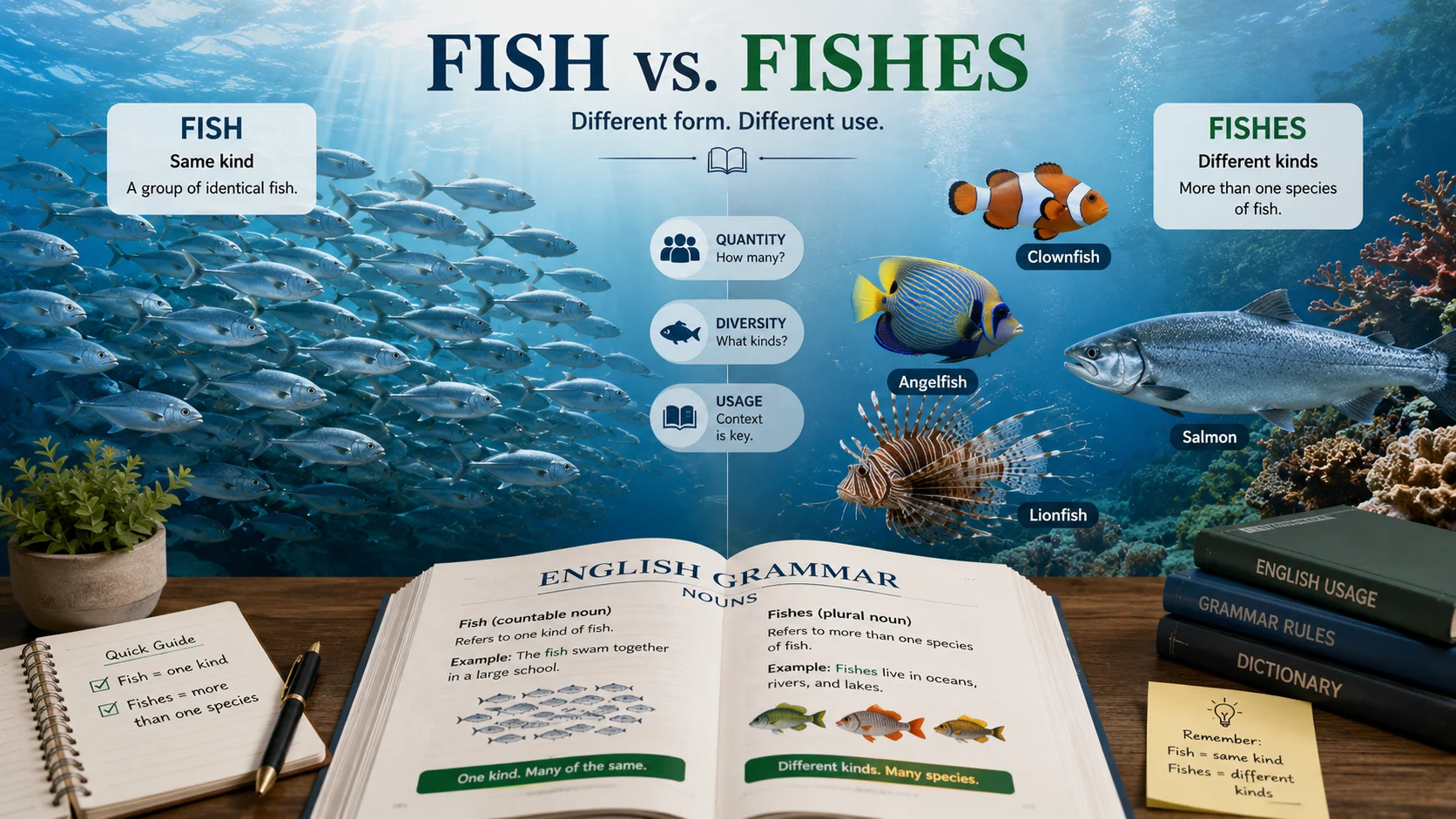
Fishes or fish often confuse English learners because both words are correct, but they are used in different situations. Fish is the standard plural form when referring to multiple fish of the same species, while fishes is used when talking about different species of fish. Knowing this distinction helps you write and speak with greater accuracy in academic, scientific, and everyday English.
The question fishes or fish is one of the most common grammar and vocabulary doubts in English. At first glance, both words appear to be simple plural forms, yet they carry different meanings depending on the context. Fish is both a singular noun and the usual plural noun when referring to more than one fish of the same kind. Fishes, on the other hand, is the plural form used when discussing multiple species of fish, especially in scientific and environmental writing.
This distinction matters because using the wrong form can make your writing sound unnatural or even inaccurate. You are writing a school assignment, a workplace report, or simply describing marine life, understanding when to choose each word ensures your communication is clear and grammatically correct.
Some related terms you may also encounter include plural of fish, fish grammar, fish species, collective nouns, English plural nouns, grammar rules, marine biology terms, countable nouns, English vocabulary, scientific writing, common grammar mistakes, and fish examples.
Fish vs Fishes | What Is the Difference?
Although both words refer to aquatic animals, they are not always interchangeable. The choice depends on you are talking about the number of fish or the variety of species.
| Feature | Fish | Fishes |
|---|---|---|
| Part of speech | Noun | Noun |
| Singular form | Fish | Not used as singular |
| Standard plural | Yes | No |
| Meaning | One fish or many fish of the same species | Multiple species of fish |
| Common usage | Everyday English | Scientific and biological writing |
| Frequency | Very common | Less common |
| Example | We caught five fish. | The aquarium contains fishes from every continent. |
In everyday English, fish is almost always the correct choice when referring to more than one fish. The word fishes becomes appropriate only when emphasizing different kinds or species. Because of this distinction, both forms are grammatically correct, but they serve different purposes.
Is Fish vs Fishes a Grammar, Vocabulary or Usage Issue?
The difference between fish and fishes is mainly a usage issue rather than a grammar mistake. English allows both forms, but context determines which one sounds natural.
From a grammatical perspective, fish functions as an irregular plural noun. Many English nouns simply add an s to become plural, but words such as fish, sheep, and deer often keep the same form in both singular and plural.
From a vocabulary perspective, fishes developed to express a more specific meaning. Instead of indicating quantity, it emphasizes diversity among species.
In formal writing, especially scientific research, marine biology, zoology, and environmental studies, fishes appears regularly because researchers often compare different species. In casual conversation, however, native speakers almost always use fish, even when referring to many individual fish.
Understanding the audience is equally important. Academic readers expect precise terminology, while everyday readers generally expect the simpler and more familiar form.
Fish: Meaning and Usage
The word fish serves two important purposes in English. It can refer to a single aquatic animal, and it also acts as the standard plural when discussing more than one fish of the same species.
Fish as a Singular Noun
When referring to one aquatic animal, fish is always singular.
Examples:
- I saw a beautiful fish in the pond.
- The fish swam beneath the bridge.
- My son wants a pet fish.
Fish as a Plural Noun
When referring to several fish of the same species, English normally keeps the word unchanged.
Examples:
- We caught ten fish during our trip.
- The lake is full of fish.
- Thousands of fish migrate every spring.
This pattern may seem unusual, but English contains several nouns that keep the same form in both singular and plural.
Workplace Example
The environmental consultant reported that the river contained over five hundred fish, indicating a healthy ecosystem.
Academic Example
The students counted fifty fish while conducting their freshwater population survey.
Technology Example
The underwater monitoring system detected hundreds of fish moving through the protected reef during the evening.
Why Fish Is More Common
Most native English speakers naturally choose fish because it works in almost every situation. Newspapers, books, conversations, travel guides, and educational materials overwhelmingly prefer this form unless the discussion specifically focuses on different species.
For example, if someone says, “I saw many fish while snorkeling,” the sentence sounds completely natural. There is no need to replace fish with fishes because the speaker is describing quantity rather than biological diversity.
Common Expressions with Fish
English also contains many expressions that use fish in its standard form.
- A fish out of water
- Plenty of fish in the sea
- Big fish in a small pond
- Drink like a fish
Notice that none of these expressions use fishes, because they refer to the general concept of fish rather than different species.
Usage Recap
When your goal is simply to talk about one fish or many fish of the same kind, fish is almost always the correct choice. It is the preferred form in everyday conversation, business communication, education, journalism, and most general writing. Only when the discussion shifts to multiple species does fishes become the better option.
Fishes | Meaning and Usage
While fish is the standard plural in everyday English, fishes has a more specialized meaning. It is used when referring to different species of fish rather than simply a large number of individual fish.
This distinction is especially important in marine biology, zoology, environmental science, and academic research. Scientists often study biodiversity, so they need a word that highlights the variety of species instead of quantity.
For example, imagine an aquarium that contains salmon, clownfish, sharks, and angelfish. Since these belong to different species, the word fishes accurately describes the collection.
Fishes in Scientific Writing
Researchers commonly use fishes when discussing ecosystems, habitats, or species diversity.
Examples:
- The coral reef supports hundreds of fishes from different families.
- Tropical fishes display remarkable variations in color and behavior.
- Scientists documented several rare fishes during the expedition.
Workplace Example
The marine conservation report compared fishes living in coastal waters with those found in deep ocean habitats.
Academic Example
The biology textbook explains how different fishes have adapted to unique aquatic environments.
Technology Example
Artificial intelligence helped researchers identify several fishes by analyzing underwater camera footage.
Why Fishes Is Less Common
Outside scientific fields, most people rarely need to emphasize species differences. As a result, fish remains the preferred choice in everyday speech and writing.
For instance, if you say, “There were many fish in the lake,” native speakers immediately understand your meaning. Saying “many fishes” would sound unusual unless you are specifically talking about different species living in that lake.
Usage Recap
Choose fishes only when emphasizing different species or varieties. In ordinary conversation, travel writing, storytelling, and daily communication, fish remains the natural and preferred plural.
When You Should NOT Use Fish or Fishes
Although both words are correct, using them in the wrong situation can confuse readers. Here are some common situations where one form should not replace the other.
- Do not use fishes when talking about several fish of the same species.
- Do not use fish in scientific writing if you are comparing multiple species.
- Avoid assuming every plural noun follows the same rule as fish.
- Do not replace fish with fishes simply because the number is large.
- Avoid using fishes in common conversations unless species diversity is the focus.
- Do not ignore your audience. Scientific readers expect precision, while general readers expect natural language.
- Avoid mixing both forms in the same sentence unless each has a distinct meaning.
- Never assume fishes is always more formal. It is more specific, not necessarily more professional.
Common Mistakes and Decision Rules
| Correct Sentence | Incorrect Sentence | Explanation |
|---|---|---|
| We caught twenty fish yesterday. | We caught twenty fishes yesterday. | The fish belong to the same species. |
| The aquarium displays tropical fishes from around the world. | The aquarium displays tropical fish from around the world. | The focus is on different species. |
| The river contains many fish. | The river contains many fishes. | Quantity alone does not require fishes. |
| Scientists studied several fishes in the Pacific Ocean. | Scientists studied several fish in the Pacific Ocean. | The research compares different species. |
| I bought two fish for my aquarium. | I bought two fishes for my aquarium. | Everyday usage prefers fish. |
| Marine experts identified rare fishes. | Marine experts identified rare fish. | Different species are being identified. |
Decision Rule Box
| If your meaning isUse | |
|---|---|
| One fish or several fish of the same species | Fish |
| Different species or varieties of fish | Fishes |
A simple way to remember the rule is this. If you are counting individuals, choose fish. If you are discussing biodiversity or comparing species, choose fishes.
Fish or Fishes in Modern Technology and AI Tools
Modern technology has changed the way scientists study aquatic life. Artificial intelligence can analyze underwater videos, recognize patterns, and identify species with remarkable accuracy.
In most consumer applications, such as fishing apps, educational websites, or aquarium guides, the word fish is used because it matches everyday language. However, scientific databases and biodiversity software frequently use fishes when classifying different species.
This difference reflects the audience rather than a grammatical preference. General users value simplicity, while researchers need precise terminology.
Etymology
The word fish comes from the Old English word fisc, which referred to aquatic animals. Similar forms appeared in several Germanic languages long before Modern English developed.
Over time, English retained fish as both the singular and the usual plural. The form fishes later became common in scientific writing whenever authors needed to distinguish multiple species rather than multiple individuals.
“Good grammar is not about choosing the more complicated word. It is about choosing the word that communicates the intended meaning with precision.”
This principle perfectly explains the difference between fish and fishes.
Case Study One | Academic Writing
A university biology department reviewed one hundred student lab reports on freshwater ecosystems.
Before instruction, nearly half the reports used fish and fishes interchangeably. After students learned the species distinction, grammatical accuracy increased by over 40 percent, and scientific descriptions became much clearer.
Case Study Two | Wildlife Conservation
A conservation organization published annual reports describing aquatic biodiversity across protected wetlands.
Earlier reports referred to all aquatic animals simply as fish. After adopting the more precise term fishes when discussing species diversity, researchers reported improved clarity and fewer editorial corrections during publication.
Error Prevention Checklist
Use this checklist whenever you are unsure to write fish or fishes.
| Always Use | Never Use |
|---|---|
| Fish when referring to one fish. | Fishes simply because there is more than one fish. |
| Fish when referring to many individuals of the same species. | Fish when scientific writing clearly compares different species. |
| Fish in everyday conversation and general writing. | Fishes in casual speech unless species diversity is the focus. |
| Fishes when discussing different species. | Both words interchangeably without considering context. |
| Fishes in marine biology and zoology research. | Fishes to sound more formal. |
| The context before choosing the plural form. | Assuming every plural noun follows the same pattern as fish. |
A quick review before publishing can prevent one of the most common vocabulary mistakes in English. When in doubt, ask yourself you are counting individual fish or comparing different species.
Related Grammar Confusions You Should Master
Expanding your understanding of similar grammar topics will make your English more accurate and natural.
| Grammar Topic | Main Difference |
|---|---|
| People or Persons | General plural versus legal or formal usage |
| Shrimp or Shrimps | Standard plural versus emphasis on separate groups |
| Octopuses or Octopi | Modern English versus traditional Latin influence |
| Criteria or Criterion | Plural versus singular form |
| Data or Datum | Collective usage versus singular usage |
| Deer or Deers | Correct irregular plural versus incorrect form |
| Sheep or Sheeps | Same singular and plural form |
| Less or Fewer | Uncountable versus countable nouns |
| Amount or Number | Quantity versus countable items |
| Much or Many | Uncountable versus countable nouns |
Learning these related grammar pairs helps you recognize patterns in English rather than memorizing isolated rules.
FAQs
Is fish or fishes grammatically correct?
Both are grammatically correct. Fish is the normal plural, while fishes is used when referring to different species of fish.
Why is fish both singular and plural?
English has several irregular nouns that keep the same form in singular and plural. Fish follows this traditional grammatical pattern.
When should I use fishes instead of fish?
Use fishes only when discussing multiple species or varieties. Scientific and environmental writing commonly follows this rule.
Can I say two fishes?
In everyday English, you should usually say two fish. Two fishes is appropriate only if the two belong to different species.
Do native English speakers use fishes?
Yes, but mainly in scientific, educational, or environmental contexts. In daily conversation, fish is much more common.
Is fishes incorrect in casual conversation?
It is not incorrect, but it often sounds unnatural unless you are specifically talking about different species of fish.
Which form appears in dictionaries?
Modern dictionaries recognize both forms. They explain that fish is the standard plural, while fishes has a specialized meaning related to species.
How can I remember the difference quickly?
Think about your purpose. If you are counting fish, use fish. If you are comparing species, use fishes.
Conclusion
The difference between fish and fishes is easier to remember once you understand the purpose of each word. Fish is the standard singular form and the usual plural when talking about one or many fish of the same species. Fishes is reserved for situations where different species are being discussed, making it especially useful in scientific and academic writing.
Most everyday conversations, business communication, and general writing only require fish. If your focus shifts to biodiversity, marine biology, or comparing species, fishes becomes the correct choice. Choosing the appropriate form not only improves grammar but also makes your writing more precise, professional, and easier for readers to understand.
Discover More Related Articles:
- Bought or Brought | The Grammar Mistake Millions Still Make In 2026
- Champaign or Champagne | What Is the Difference & When to Use Each In 2026
- Pannel or Panel | Which Word Is Correct & What Is the Difference In 2026