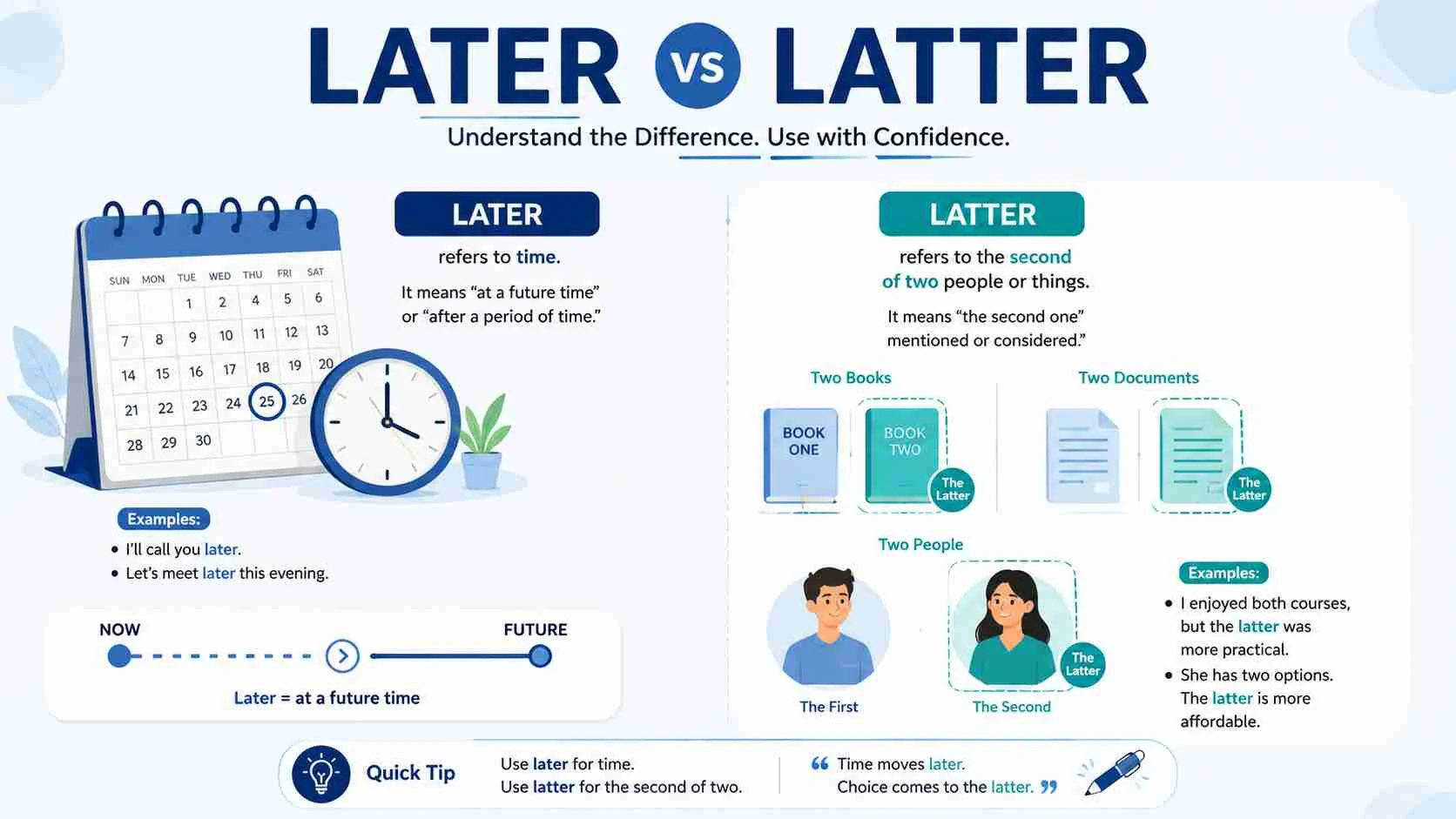
Later and latter are commonly confused because they look and sound similar, but they have different meanings and uses. Later refers to time and means after a particular point or at a future time, while latter refers to the second of two people, things, or ideas mentioned.
The confusion between later or latter is one of the most common challenges English learners and even native speakers face. Although the two words differ by only one letter, they serve completely different purposes in English. Later is an adverb, adjective, or noun that relates to time, whereas latter is an adjective and pronoun used to identify the second item in a pair.
Mixing these words can change the meaning of a sentence, create misunderstandings, and make professional or academic writing appear less polished. You’re writing an email, preparing an assignment, or creating online content, knowing when to use each word correctly is an essential grammar skill.
This guide explains the difference between later and latter, provides practical examples, highlights common mistakes, and offers simple rules you can remember every time you write.
Later vs Latter | What’s the Difference?
Although later and latter are similar in spelling and pronunciation, they are not interchangeable. The key difference is simple:
- Later relates to time and means after now or after a particular moment.
- Latter refers to the second of two people, objects, ideas, or options that have already been mentioned.
| Feature | Later | Latter |
|---|---|---|
| Part of speech | Adverb, adjective, noun | Adjective, pronoun |
| Meaning | At a future time or after a specific point | The second of two mentioned items |
| Refers to | Time | Position in a pair |
| Can replace the other? | No | No |
| Example | I’ll call you later. | Between tea and coffee, I prefer the latter. |
To remember the difference, think of later as a word connected with time. Think of latter as a word connected with the last item in a list of two. Once you associate each word with its specific purpose, choosing the correct one becomes much easier.
Is Later vs Latter a Grammar, Vocabulary or Usage Issue?
The confusion between later and latter is primarily a vocabulary and usage issue, although it also affects grammar because each word belongs to different parts of speech.
These words are not interchangeable. Replacing one with the other changes the meaning of a sentence and can make your writing incorrect.
In formal writing, using the correct word is especially important because precision improves clarity and credibility. Academic papers, business reports, and professional emails all require careful word choice.
In casual conversation, people occasionally confuse the two because they sound similar. However, using the correct term still helps avoid misunderstandings, especially when discussing schedules, comparisons, or choices.
Understanding Later
Later refers to time. It indicates that something happens after the present moment or after another event.
Examples include everyday conversations, professional communication, and written English.
Workplace example
“The manager will review your proposal later this afternoon.”
Academic example
“The professor will discuss this topic later in the semester.”
Technology example
“The software update will be available later this week.”
You can also use later as an adjective.
The later chapters explain the concept in greater detail.
As a noun, it appears in informal expressions.
“See you later!”
Usage Recap
Whenever you’re talking about time, sequence, or something happening in the future, later is the correct choice.
Understanding Latter
Latter identifies the second of two people, things, ideas, or options that have already been mentioned.
It always points back to something previously introduced and never refers to time.
Workplace example
“We considered hiring an experienced manager or promoting an existing employee. We chose the latter.”
Academic example
“The study compares qualitative and quantitative research methods. The latter provides numerical data.”
Technology example
“You can store your files locally or in the cloud. The latter offers easier access from multiple devices.”
Notice that latter only works when exactly two items are being compared. If more than two items are listed, using latter usually creates confusion because readers cannot clearly identify which item you mean.
Usage Recap
Use latter only when referring to the second of two previously mentioned people, objects, ideas, or choices. It does not indicate time and should never replace later.
When You Should Not Use Later or Latter
Even though later and latter are easy to distinguish once you know their meanings, they are still misused in everyday writing. Avoid these common situations to keep your English clear and accurate.
- Do not use later when referring to the second of two choices.
Incorrect: I prefer coffee over tea. I chose later.
Correct: I prefer coffee over tea. I chose the latter. - Do not use latter to describe a future time.
Incorrect: I’ll reply latter.
Correct: I’ll reply later. - Do not use latter if only one item has been mentioned.
The word must refer back to the second of two previously stated options. - Do not use later as a substitute for last or final.
These words have different meanings and are not interchangeable. - Do not use latter when discussing three or more items unless the context clearly limits the comparison to the last two.
- Do not assume similar spelling means similar meaning.
These words belong to different grammatical categories and serve different purposes. - Do not rely only on pronunciation.
Because later and latter sound alike in many accents, always consider the meaning of the sentence.
Common Mistakes and How to Fix Them
| Correct Sentence | Incorrect Sentence | Explanation |
|---|---|---|
| I’ll finish the report later. | I’ll finish the report latter. | The sentence refers to future time. |
| Between history and geography, I prefer the latter. | Between history and geography, I prefer later. | The sentence refers to the second option. |
| We can discuss the issue later. | We can discuss the issue latter. | The meaning involves time. |
| The book compares fiction and nonfiction. The latter is discussed first. | The book compares fiction and nonfiction. Later is discussed first. | The sentence identifies the second item mentioned. |
| She arrived later than expected. | She arrived latter than expected. | Arrival relates to time. |
| We considered renting and buying. We chose the latter. | We considered renting and buying. We chose later. | The sentence selects the second option. |
Decision Rule
If you mean time or something happening afterward, use later.
If you mean the second of two people, things, or ideas, use latter.
Later and Latter in Modern Technology and AI Tools
Modern writing tools, grammar checkers, and AI assistants are becoming better at distinguishing later from latter, but they are not perfect. If the surrounding context is unclear, even advanced language models may suggest the wrong word.
For example, an AI tool can easily recognize “I’ll update the document later.” However, it may struggle if a sentence lacks enough context to determine the writer is referring to time or to the second option in a comparison.
The best approach is to understand the meaning yourself rather than relying entirely on automated corrections. Human judgment remains essential for accurate communication.
The Origin of Later and Latter
The words later and latter share historical roots in Old English and have been part of the language for centuries.
Later developed from comparative forms meaning after or more late, gradually becoming the standard word for referring to a future time or a point further along in a sequence.
Latter comes from an older comparative form meaning more late in the sense of the second or the one that follows. Over time, its meaning became specialized, referring specifically to the second of two previously mentioned items.
Although their spellings remain similar because of their shared linguistic history, their meanings have evolved into two distinct concepts.
“Strong writing depends on choosing words for their meaning, not merely their similarity in spelling or pronunciation. Small distinctions often make the greatest difference in clarity.”
Editorial guidance based on standard English usage
Real World Case Studies
Case Study 1: Business Communication
A customer support team noticed repeated confusion in client emails because employees frequently wrote “Please choose the later option” instead of “Please choose the latter option.”
After introducing a short grammar guide and reviewing common word pairs during staff training, internal quality checks showed a significant reduction in language errors. Customer feedback also indicated that written instructions were easier to understand.
Case Study 2: University Writing Support
A university writing center analyzed student essays and found that later and latter were among the most commonly confused word pairs.
After tutors incorporated targeted practice exercises and comparison examples into writing workshops, students demonstrated noticeably better accuracy in assignments and fewer grammar corrections during final assessments.
Error Prevention Checklist
Always use later when
- Referring to the future.
- Talking about time.
- Describing something that happens afterward.
- Comparing events in a timeline.
- Saying goodbye in expressions such as See you later.
Never use later when
- Referring to the second of two choices.
- Replacing latter in comparisons.
Always use latter when
- Referring to the second of two people.
- Referring to the second of two objects.
- Referring to the second of two ideas or options.
- Pointing back to something already mentioned.
Never use latter when
- Talking about future time.
- Describing schedules or deadlines.
- Referring to only one item.
- Replacing later in time related expressions.
Related Grammar Confusions You Should Master
Improving your English involves understanding many commonly confused word pairs. After mastering later and latter, consider learning the differences between these terms:
- Affect vs Effect
- Then vs Than
- Farther vs Further
- Fewer vs Less
- Who vs Whom
- Its vs It’s
- Lay vs Lie
- Among vs Between
- Beside vs Besides
- Accept vs Except
FAQs
What is the difference between later and latter?
Later refers to time and means after now or at a future point. Latter refers to the second of two people, things, or ideas that have already been mentioned. Although the words look similar, they are never interchangeable.
Is it correct to say later or latter?
It depends on the meaning of your sentence. Use later when talking about time, and use latter when referring to the second of two options. Choosing the correct word ensures your writing is clear and grammatically accurate.
How can I remember the difference between later and latter?
A simple memory trick is to associate later with time and latter with the last of two. If your sentence involves the future, choose later. If it points to the second item in a pair, choose latter.
Can later and latter be used interchangeably?
No. These words have different meanings and grammatical functions. Replacing one with the other changes the meaning of a sentence and often results in incorrect English.
Is latter always used with two items?
Yes. Latter normally refers to the second of two previously mentioned people, objects, or ideas. If you mention more than two items, it is usually clearer to repeat the specific noun instead of using latter.
Which is correct: “See you later” or “See you latter”?
The correct expression is “See you later.” This phrase refers to meeting someone at a future time. Latter cannot be used because it does not relate to time.
Is latter formal English?
Yes. Latter is common in both formal and academic writing because it avoids repeating a noun when comparing two items. It also appears in everyday English, although it is less common in casual conversation than later.
Can AI grammar checkers confuse later and latter?
Modern grammar tools and AI writing assistants are generally good at identifying the correct word, but they can make mistakes if a sentence lacks context.
Conclusion
Understanding later or latter is easier once you remember that each word serves a different purpose. Later always relates to time, indicating that something happens after the present moment or after another event. Latter, on the other hand, identifies the second of two people, things, or ideas that have already been mentioned.
Although the two words differ by only one letter, using the wrong one can change the meaning of your sentence and reduce the clarity of your writing. You are preparing an academic paper, writing a professional email, or communicating in everyday situations, choosing the correct term demonstrates precision and confidence.