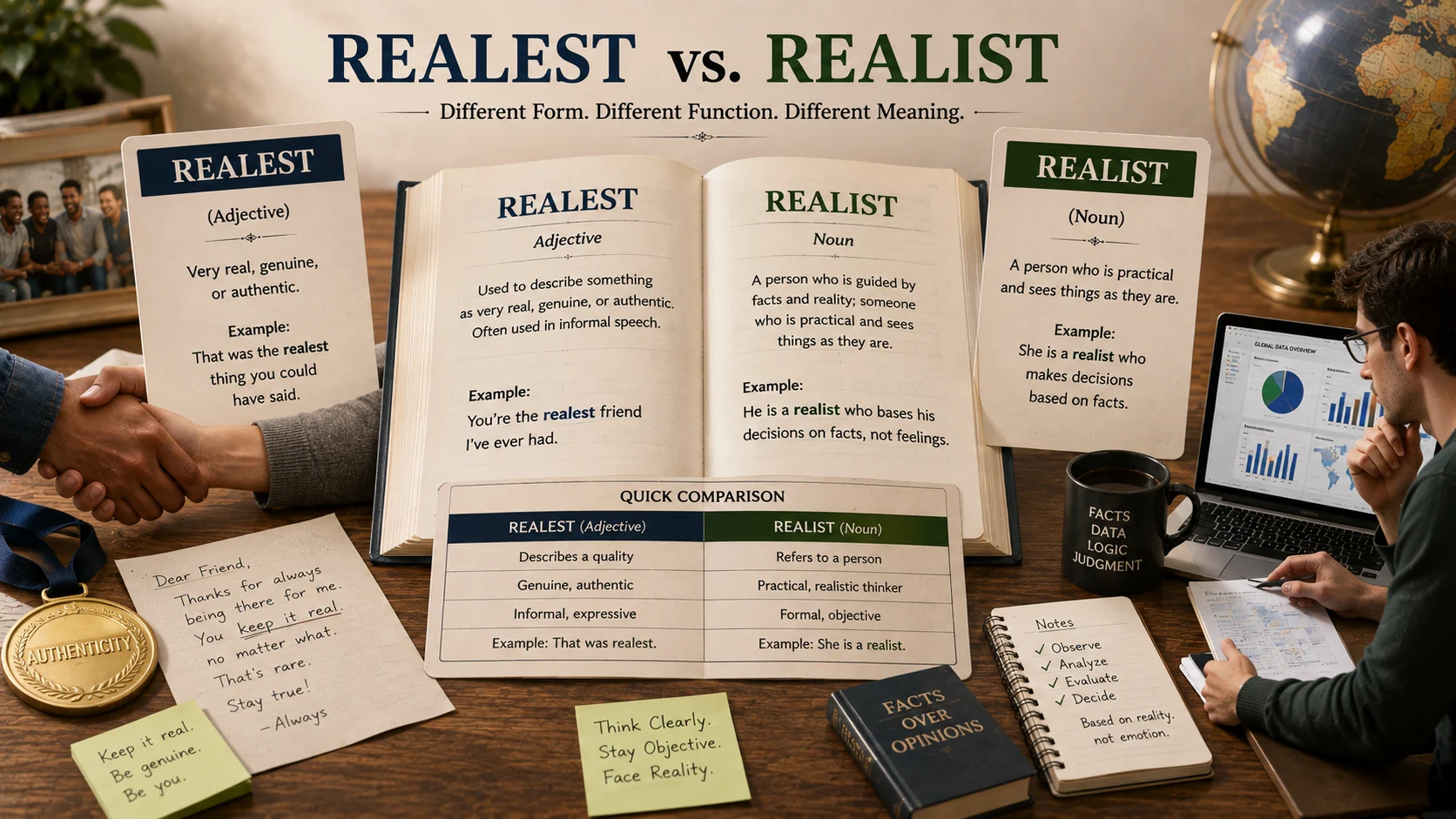
The terms realest or realist are often confused because they both come from the word real but serve completely different purposes. Realest is the superlative form of the adjective real and describes someone or something as the most genuine or authentic. Realist is a noun that refers to a person who sees situations as they truly are rather than through idealism.
Realest or Realist |Understanding the Difference
English contains many words that look alike but carry very different meanings. Realest or realist is one of those pairs that frequently causes confusion among students, writers, and even fluent speakers. Although both words share the same root, they belong to different parts of speech and cannot replace one another in most sentences.
The word realest describes the highest degree of authenticity, sincerity, or genuineness. It answers questions such as Who is the most genuine? or Which option feels the most authentic?
The word realist, on the other hand, names a person. A realist accepts facts, evaluates situations objectively, and avoids unrealistic expectations. Instead of describing something, it identifies someone’s outlook or way of thinking.
Confusing these words can create grammatical mistakes and change the meaning of a sentence completely. Knowing when to use each one will make your writing clearer, more professional, and easier for readers to understand.
Realest vs Realist | What’s the Difference?
Although these words share the same root, they perform different grammatical functions and express different ideas.
| Feature | Realest | Realist |
|---|---|---|
| Part of speech | Adjective | Noun |
| Meaning | Most genuine, authentic, or true | A person who views reality objectively |
| Describes | A person, place, object, or idea | A person |
| Comparative form | Real, realer, realest | Not applicable |
| Can replace the other? | No | No |
| Common contexts | Personal qualities, relationships, branding | Personality, philosophy, politics, economics, literature |
A simple way to remember the difference is that realest describes how genuine someone or something is, while realist identifies who a person is. One measures authenticity, whereas the other names a mindset.
Understanding this distinction prevents awkward wording and improves both academic and everyday communication.
Is Realest or Realist a Grammar, Vocabulary or Usage Issue?
The confusion between these two words is mainly a vocabulary and usage issue, not a grammar problem. Each word is grammatically correct when used in the right context. Problems arise only when one is substituted for the other.
Are They Interchangeable?
No.
These words are not interchangeable because they belong to different grammatical categories. One functions as an adjective, while the other functions as a noun.
For example:
- She is the realest friend I have. ✔
- She is the realist friend I have. ✘
Likewise:
- He is a realist who always considers the facts. ✔
- He is a realest who always considers the facts. ✘
Changing the word changes the sentence from correct to incorrect.
Formal Versus Informal Usage
The word realist is common in both formal and informal English. It appears regularly in academic writing, journalism, philosophy, psychology, economics, and political discussions.
Examples include:
- The economist remained a realist during the financial crisis.
- Many historians describe the leader as a political realist.
The word realest appears much more often in informal conversation, entertainment, music, and social media. People use it to praise honesty, loyalty, or authenticity.
Examples include:
- She’s the realest person I’ve ever met.
- That was the realest conversation we’ve had.
Although acceptable in standard English, realest is considerably less common in formal academic writing.
Academic Versus Casual Usage
In academic settings, realist has a precise meaning and often refers to a philosophical position, literary movement, or practical way of thinking.
For example:
- A realist evaluates evidence before reaching conclusions.
- Literary realism influenced many nineteenth century novelists.
In casual speech, realest is often used to compliment someone’s honesty or character.
For example:
- Thanks for always being the realest friend.
- He’s one of the realest people on the team.
Both words are correct within their own contexts, but choosing the wrong one immediately signals a misunderstanding of their meanings.
Why This Difference Matters
Writers often assume that because both words come from real, they can be exchanged freely. That assumption leads to confusing sentences and weak communication.
Choosing the correct word demonstrates vocabulary accuracy, improves readability, and helps readers understand exactly what you mean without stopping to interpret your sentence.
You are writing an essay, preparing a business report, or posting on social media, recognizing the distinction between realest and realist makes your language more precise and credible.
Realest | Meaning, Usage and Examples
Realest is the superlative form of the adjective real. It means the most genuine, authentic, honest, or true among a group of people or things. It compares three or more subjects and highlights the highest level of authenticity.
People often use this word when describing someone’s character, emotions, experiences, or relationships. It is especially common in everyday conversations, interviews, music, and social media where authenticity is valued.
Workplace Example
During the meeting, everyone appreciated Maya because she gave the realest feedback without trying to impress anyone.
Academic Example
Among all the historical accounts, the professor considered the original diary the realest source because it came directly from the eyewitness.
Technology Example
Users praised the latest virtual reality simulator for delivering the realest driving experience available today.
More Example Sentences
- She remained the realest friend throughout difficult times.
- That documentary tells the realest story of the event.
- His apology sounded like the realest one we had heard.
- The museum created the realest reconstruction of the ancient city.
- Many readers described the novel as the realest portrayal of modern family life.
Usage Recap
Remember that realest always compares authenticity or genuineness. If your sentence answers the question Which one is the most genuine or authentic? then realest is likely the correct choice.
Realist | Meaning, Usage and Examples
A realist is a noun referring to a person who accepts facts, evaluates situations objectively, and avoids unrealistic expectations. Rather than focusing on wishes or ideal outcomes, a realist considers practical evidence before making decisions.
The word also has specialized meanings in philosophy, literature, art, economics, and international relations, where it describes individuals or schools of thought that emphasize reality over imagination or idealism.
Workplace Example
The project manager acted as a realist, explaining that the deadline needed to be extended to maintain quality.
Academic Example
The student described Aristotle as a realist in certain philosophical discussions about knowledge and reality.
Technology Example
A cybersecurity realist understands that no computer system can ever be completely immune to attacks.
More Example Sentences
- She is a realist who carefully studies every option.
- A successful entrepreneur must also be a realist about market conditions.
- The coach remained a realist despite the team’s early victories.
- Every negotiation benefits from having at least one realist in the room.
- His friends admire him because he is optimistic without forgetting to be a realist.
Usage Recap
Use realist only when referring to a person or someone identified by a practical view of reality. It names an individual rather than describing the level of authenticity.
When You Should NOT Use Realest or Realist
Even experienced writers occasionally misuse these words because they share the same root. Avoid these common situations.
| Situation | Correct Choice | Why |
|---|---|---|
| Referring to the most genuine friend | Realest | You are describing authenticity. |
| Naming a practical thinker | Realist | You are identifying a person. |
| Comparing honesty among several people | Realest | A superlative adjective is required. |
| Discussing philosophy or politics | Realist | It refers to a person or school of thought. |
| Describing an authentic experience | Realest | The focus is on genuineness. |
| Replacing one word with the other because they look similar | Neither | They have different meanings and grammar. |
| Using realist as an adjective | Avoid | Realist functions primarily as a noun. |
| Using realest to describe a worldview | Avoid | It cannot identify a philosophical position. |
The easiest way to avoid mistakes is to ask yourself you are describing authenticity or naming a type of person. The answer usually reveals the correct word immediately.
Common Mistakes and Decision Rules
The following examples show errors that frequently appear in student writing and online content.
| Correct Sentence | Incorrect Sentence | Explanation |
|---|---|---|
| She is the realest friend I know. | She is the realist friend I know. | The sentence describes authenticity. |
| He is a realist who accepts criticism calmly. | He is a realest who accepts criticism calmly. | The sentence names a person. |
| This is the realest painting in the exhibition. | This is the realist painting in the exhibition. | The focus is on how authentic something appears. |
| The professor is a political realist. | The professor is a political realest. | A noun is required. |
| That conversation felt the realest. | That conversation felt the realist. | The sentence compares authenticity. |
| She became a respected realist after years of experience. | She became a respected realest after years of experience. | The word identifies a person. |
Decision Rule Box
| If your meaning is… | Use |
|---|---|
| The most genuine, authentic, or honest | Realest |
| A practical person who accepts reality | Realist |
A quick memory trick is this: realest describes a quality, while realist identifies a person.
Realest and Realist in Modern Technology and AI Tools
Modern writing assistants, grammar checkers, and artificial intelligence tools have become much better at distinguishing between these words, but they still rely heavily on context. If a sentence lacks enough surrounding information, an automated system may occasionally suggest the wrong option.
For example, an AI writing tool can usually recognize that She is the realest teammate requires an adjective, while He is a realist who evaluates every risk requires a noun. Even so, writers should always review automated suggestions instead of accepting them without question.
Understanding the difference yourself remains the most reliable way to produce clear and accurate writing.
The Origin of Realest and Realist
The adjective real comes from the Latin word realis, meaning actual or existing. Over time, English developed the comparative form realer and the superlative form realest to express increasing degrees of authenticity or truth.
The noun realist appeared later by adding the ending ist, a suffix commonly used to identify a person associated with a belief, profession, or way of thinking. Similar examples include artist, scientist, and journalist.
Although both words share the same linguistic root, they evolved to perform different roles in modern English.
Precise vocabulary is the foundation of clear thinking. Choosing the correct word allows readers to understand your meaning without hesitation.
Case Study One | Improving Academic Writing
A university writing center reviewed one hundred student essays and found that several learners confused realest with realist when discussing philosophy and literature. After a focused vocabulary lesson explaining parts of speech and context, the error rate dropped significantly in the following semester, resulting in clearer academic writing and stronger grades.
Case Study Two | Better Business Communication
A marketing agency noticed inconsistent wording in client presentations. Team members sometimes referred to a practical customer as the realest buyer instead of a realist buyer. After introducing an internal style guide with examples and editing exercises, client documents became more consistent and required fewer editorial revisions before publication.
Error Prevention Checklist
Use this simple checklist whenever you are unsure which word belongs in your sentence.
| Always use Realest when | Never use Realest when |
|---|---|
| Comparing authenticity among three or more people or things | Referring to a person with a practical outlook |
| Describing the most genuine friend or experience | Discussing philosophy or political theory |
| Talking about honesty or sincerity | Naming a type of thinker |
| Expressing the highest degree of authenticity | Identifying a profession or belief |
| Always use Realist when | Never use Realist when |
|---|---|
| Referring to a person who accepts reality | Comparing honesty or authenticity |
| Discussing philosophy, literature, or politics | Describing the most genuine object |
| Naming someone’s practical mindset | Replacing a superlative adjective |
| Talking about objective thinking | Ranking people by sincerity |
A quick review before publishing can prevent these common vocabulary mistakes and make your writing sound more polished.
Related Grammar Confusions You Should Master
Expanding your vocabulary means learning other commonly confused word pairs as well. These topics frequently appear in English writing and standardized tests.
| Grammar TopicWhy It Causes Confusion | |
|---|---|
| Further or Farther | Distance versus degree |
| Affect or Effect | Verb versus noun |
| Advice or Advise | Noun versus verb |
| Principal or Principle | Person versus rule |
| Stationary or Stationery | Motion versus writing materials |
| Historic or Historical | Importance versus relation to history |
| Beside or Besides | Position versus addition |
| Complement or Compliment | Complete versus praise |
| Personal or Personnel | Individual versus employees |
| Immigrate or Emigrate | Direction of movement |
Mastering these distinctions strengthens your grammar, improves clarity, and builds confidence in both professional and academic writing.
FAQs
What is the difference between realest and realist?
Realest describes the highest level of authenticity, while realist refers to a person who accepts reality objectively. They belong to different parts of speech and cannot be used interchangeably.
Is realest a real word in English?
Yes. Realest is the accepted superlative form of the adjective real. It is commonly used in everyday English to describe someone or something as the most genuine.
Is realist a noun or an adjective?
Realist is primarily a noun. It identifies a person who views situations realistically rather than idealistically.
Can I use realest in academic writing?
Yes, but only when comparing authenticity or genuineness. In formal academic writing, it appears less frequently than realist, which has established meanings in philosophy, literature, and politics.
Why do people confuse realest and realist?
Both words come from the adjective real, so they look similar. However, one describes authenticity and the other identifies a type of person.
How can I remember which word to use?
Think of realest as describing the most real or genuine, while realist names someone who deals with reality. This simple distinction works in almost every situation.
Can a person be both realest and a realist?
Yes. Someone can be the realest friend because they are very genuine, and also be a realist because they approach life practically.
Is realist used in philosophy?
Yes. In philosophy, realist refers to someone who believes reality exists independently of perception. The word also appears in literature, politics, and economics.
Conclusion
Understanding the difference between realest and realist is easier once you recognize that they belong to different parts of speech. Realest is a superlative adjective used to describe the highest level of authenticity, sincerity, or genuineness. Realist is a noun that identifies a person who approaches situations with practicality and accepts reality as it is.
Although the words share the same root, they cannot replace one another without changing the meaning of a sentence. Choosing the correct term improves grammar, vocabulary, and overall communication, you are writing an essay, creating professional content, or simply having a conversation.
The next time you pause between these two words, remember one simple rule. If you are describing who or what is the most genuine, choose realest. If you are talking about a person with a practical view of reality, choose realist.
Discover More Related Articles:
- Yes or No | Meaning, Differences & When to Use Each Correctly In 2026
- Gopher or Gofer | What’s the Difference & Which One Should You Use In 2026
- Fishes or Fish | Which Form Do Dictionaries Recommend In 2026