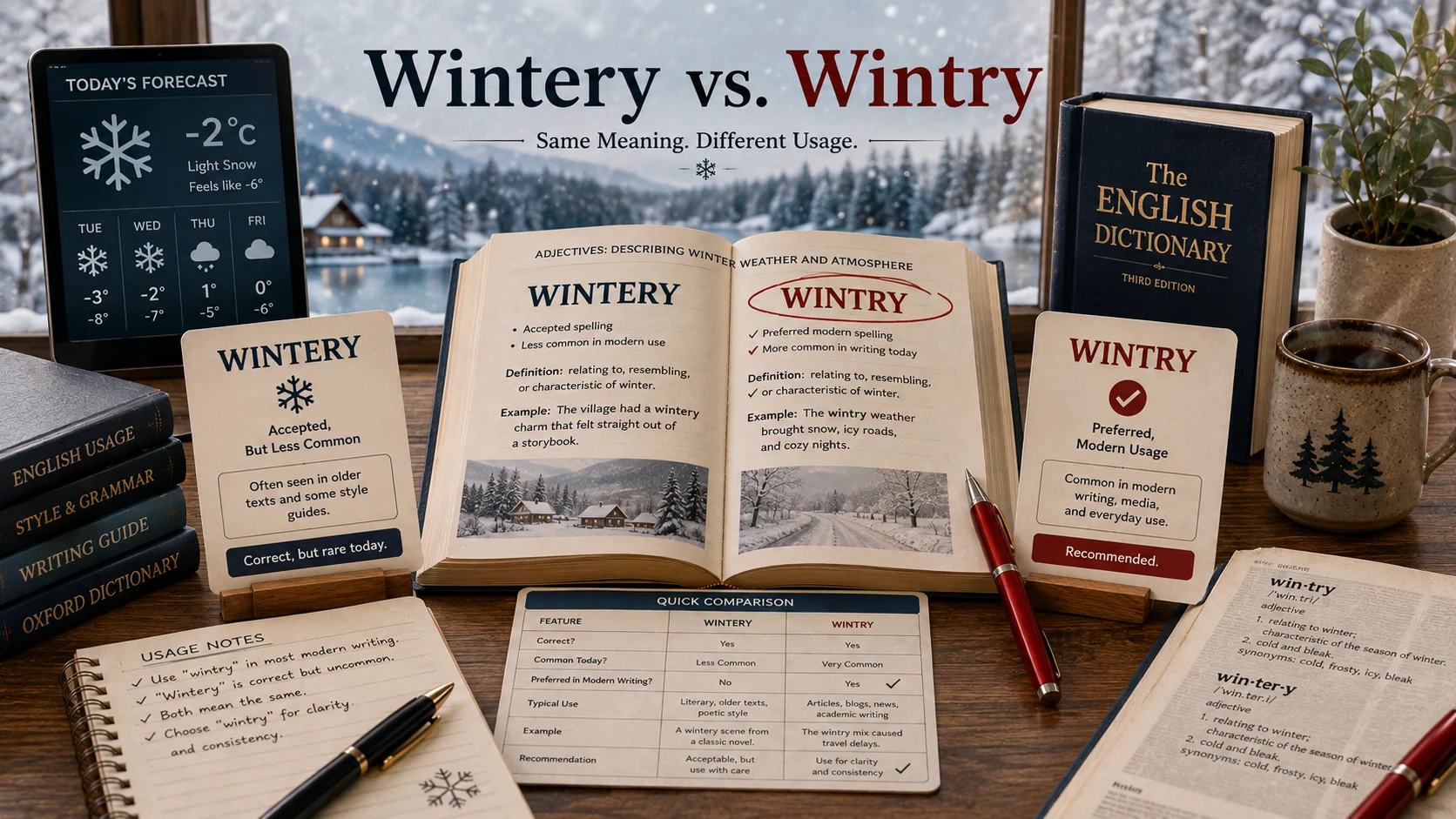
Wintery or wintry are both accepted adjectives that describe something related to winter or having the characteristics of winter. While both spellings are correct, wintry is the preferred form in modern English and appears far more often in dictionaries, style guides and professional writing. Wintery remains an accepted alternative but is much less common.
The question wintery or wintry often confuses writers because both words look correct and carry the same meaning. In fact, both wintery and wintry describe weather, scenery, or conditions that resemble winter or are typical of the cold season.
The confusion arises because one spelling is much more common than the other, leading many people to wonder one is outdated or incorrect. Understanding when each spelling is appropriate helps you write with greater confidence, especially in academic, professional, and creative contexts.
Wintery or Wintry | What’s the Difference?
Both wintery and wintry are adjectives. They describe something that has the qualities, appearance, or feeling of winter. The primary difference lies in usage frequency rather than meaning.
| Feature | Wintry | Wintery |
|---|---|---|
| Part of speech | Adjective | Adjective |
| Meaning | Having characteristics of winter | Having characteristics of winter |
| Dictionary status | Standard and preferred | Accepted alternative spelling |
| Frequency | Very common | Much less common |
| Academic writing | Preferred | Rarely used |
| Everyday writing | Preferred | Occasionally used |
| British English | Common | Less common |
| American English | Common | Less common |
Both words communicate exactly the same idea. However, wintry is the spelling that readers are most likely to recognize and expect. Choosing the standard form improves clarity and consistency, especially in formal writing.
If you are writing for school, work, or publication, wintry is almost always the safer choice. Wintery is not wrong, but it may appear unusual to many readers.
Is Wintery or Wintry a Grammar, Vocabulary or Usage Issue?
This question is mainly a usage issue, not a grammar mistake.
Grammar determines how words function in sentences. Since both words are valid adjectives, there is no grammatical difference between them.
Vocabulary concerns meaning. Again, there is no meaningful distinction because both words describe winter like conditions.
Usage is where the difference appears. Modern dictionaries and editorial style guides overwhelmingly prefer wintry because it has become the standard spelling through regular use.
In formal contexts such as academic papers, newspapers, business communication, and published books, wintry is generally expected. In casual writing, personal blogs, or creative fiction, some writers still choose wintery, although it remains far less common.
The two spellings are interchangeable in meaning, but they are not equally common in modern English.
Using Wintry Correctly
Because wintry is the preferred spelling, it appears in nearly every type of professional writing.
A wintry landscape immediately suggests snow covered fields, icy roads, frosty trees, and cold temperatures. The word creates vivid imagery while matching modern editorial standards.
Workplace Example
The travel advisory warned employees to prepare for wintry road conditions before commuting to the office.
Academic Example
Researchers observed that several bird species adapted quickly to wintry climates during seasonal migration.
Technology Example
The weather application issued alerts for wintry precipitation across the northern region.
Everyday Examples
The mountains looked wintry after the overnight snowfall.
A wintry breeze swept through the empty streets.
The cabin offered a perfect escape during the wintry season.
The painter captured a peaceful wintry forest in remarkable detail.
Usage Recap
Use wintry whenever you want the standard, widely accepted spelling. It works naturally in formal documents, journalism, education, business communication, and everyday conversation.
Using Wintery Correctly
Although wintery is less common, it is still recognized as a legitimate alternative spelling in many dictionaries.
Some writers prefer it because its formation resembles adjectives such as watery or silvery. Even so, modern English has gradually favored wintry instead.
Readers will usually understand wintery without difficulty, but they may notice it as an uncommon spelling.
Workplace Example
The marketing brochure described the resort as offering a peaceful wintery atmosphere throughout the holiday season.
Academic Example
The novel uses wintery imagery to symbolize isolation and emotional distance.
Technology Example
A game developer created a realistic wintery environment filled with snow covered villages and frozen lakes.
Everyday Examples
The garden looked wintery after the first frost.
The decorations gave the room a warm yet wintery appearance.
The artist painted a beautiful wintery mountain village.
They enjoyed the quiet wintery evening beside the fireplace.
Usage Recap
You can use wintery without being grammatically incorrect. However, because it is much less common, many editors will replace it with wintry to match current publishing standards.
When You Should NOT Use Wintery or Wintry
Even though both spellings are correct, there are situations where neither word fits naturally.
| Situation | Better Choice | Reason |
|---|---|---|
| Referring to the season itself | Winter | Use the noun instead of the adjective. |
| Naming the calendar season | Winter | The adjective is unnecessary. |
| Talking about cold without seasonal meaning | Cold or chilly | Winter like conditions are not always implied. |
| Describing freezing temperatures scientifically | Freezing or subzero | These terms are more precise. |
| Referring to snowstorms | Snowy or snowy conditions | Focus on snowfall rather than the season. |
| Discussing climate data | Seasonal or winter climate | Scientific writing prefers greater precision. |
| Describing holiday decorations only | Festive or seasonal | Decorations are not always related to weather. |
| Writing according to strict editorial style | Wintry | Preferred spelling in professional publications. |
Choosing the right descriptive word makes your writing more accurate. Sometimes another adjective communicates your meaning better than either wintery or wintry.
Common Mistakes and Decision Rules
| Correct Sentence | Incorrect Sentence | Explanation |
|---|---|---|
| The forecast predicts wintry weather tomorrow. | The forecast predicts winter weathery tomorrow. | Wintry is the correct adjective. |
| The painting has a wintry atmosphere. | The painting has a winter atmosphere when describing appearance. | Wintry better describes appearance or mood. |
| The forest looked wintery after snowfall. | The forest looked winter. | An adjective is needed. |
| Most editors prefer wintry in formal writing. | Most editors prefer wintery in academic publishing. | Wintry is the standard editorial choice. |
| The village had a wintry charm. | The village had a winter charm. | The adjective is more natural. |
| Her novel creates a wintry mood. | Her novel creates a winter mood. | The adjective describes the atmosphere more effectively. |
Decision Rule Box
| If your meaning is… | Use… |
|---|---|
| You want the standard adjective used in modern English | Wintry |
| You are following academic or professional style | Wintry |
| You are writing for newspapers or websites | Wintry |
| You prefer an accepted but uncommon alternative spelling | Wintery |
| You simply mean having the qualities of winter | Either spelling, though wintry is recommended |
Wintery or Wintry in Modern Technology and AI Tools
Modern writing tools such as grammar checkers, spell checkers, and AI assistants usually recommend wintry because it is the dominant spelling in contemporary English. Many style guides and publishing platforms also favor this form for consistency.
That said, most advanced language tools recognize wintery as a valid alternative rather than marking it as an outright error. If your audience expects formal, polished English, choosing wintry is the safest option.
Etymology
The adjective wintry comes from the Old English word winter, which referred to the coldest season of the year. Over time, English speakers developed the adjective wintry to describe weather, landscapes, or feelings associated with winter.
The spelling wintery appeared later as an alternative form, following the familiar adjective pattern seen in words such as watery and silvery. Although it remains acceptable, usage gradually shifted toward wintry, making it the preferred spelling in modern dictionaries and published writing.
Expert Insight
Good writing is not only about using correct words but also about choosing the form your readers expect. In modern English, wintry provides that clarity while preserving the exact meaning.
Case Study One | Academic Editing
A university writing center reviewed one hundred student essays describing seasonal weather. About one quarter of the papers used wintery. During editing, instructors replaced nearly every instance with wintry to align with academic style guides.
The result was greater consistency across assignments and fewer comments about spelling choices, allowing readers to focus on the content rather than the wording.
Case Study Two | Digital Publishing
A travel website updated dozens of destination articles before the holiday season. Editors standardized every occurrence of wintery to wintry across weather guides and travel blogs.
After the update, the site maintained a consistent editorial style throughout its content, creating a more professional reading experience for visitors.
Error Prevention Checklist
Always Use Wintry When
| Situation | Recommendation |
|---|---|
| Writing academic papers | ✔ Use wintry |
| Preparing business documents | ✔ Use wintry |
| Publishing online articles | ✔ Use wintry |
| Following editorial style guides | ✔ Use wintry |
| Writing news or magazine content | ✔ Use wintry |
| You want the most familiar spelling | ✔ Use wintry |
Never Choose Wintery When
| Situation | Reason |
|---|---|
| Your publisher requires standard spelling | Use wintry instead. |
| You are writing for academic journals | Editors generally prefer wintry. |
| Consistency is important across publications | Standardize with wintry. |
| Following major dictionary recommendations | Wintry is the preferred form. |
| Preparing professional reports | Use the common spelling. |
| Unsure which spelling to choose | Select wintry for safety. |
Related Grammar Confusions You Should Master
Understanding similar word pairs can strengthen your writing and reduce common language mistakes.
| Topic | Why It Matters |
|---|---|
| Gray or Grey | Regional spelling differences |
| Toward or Towards | American and British usage |
| Theater or Theatre | Standard regional spelling |
| Canceled or Cancelled | One letter versus two letters |
| Traveler or Traveller | Regional spelling preference |
| Cozy or Cosy | American and British English |
| Judgment or Judgement | Formal spelling conventions |
| Modeling or Modelling | Regional writing style |
| Advisor or Adviser | Preferred professional usage |
| Aging or Ageing | Modern spelling variation |
FAQs
Is wintry or wintery correct?
Both spellings are correct, but wintry is the preferred form in modern English because it appears more frequently in dictionaries, style guides, and published writing.
Why is wintry more common than wintery?
Language usage gradually favored wintry over time, making it the standard spelling used by most editors, educators, and professional writers today.
Can I use wintery in academic writing?
You can, but most academic style guides and editors recommend wintry for consistency with standard English conventions.
Do wintry and wintery have different meanings?
No. Both adjectives describe something that has the qualities or appearance of winter, so their meanings are identical.
Which spelling is used in American English?
American English strongly prefers wintry, although wintery is still recognized as an acceptable alternative spelling.
Which spelling is used in British English?
British English also favors wintry, making it the more common choice in newspapers, books, and educational materials.
Will grammar checkers flag wintery as incorrect?
Most modern grammar tools recognize wintery, but many recommend wintry because it is the standard spelling in formal writing.
How can I remember which spelling to use?
If you are unsure, choose wintry. It is the spelling readers expect and the one most publishers recommend.
Conclusion
Choosing between wintery and wintry is less about meaning and more about usage. Both adjectives describe something that has the qualities of winter, that is icy weather, snowy scenery, or a cold atmosphere. However, wintry has become the dominant spelling in modern English and is the version preferred by dictionaries, editors, educators, and professional publishers.
While wintery remains an accepted alternative, it appears far less often in contemporary writing. If your goal is to produce clear, polished, and professional English, wintry is the spelling to use in almost every situation. Remember this simple guideline: when describing conditions that feel like winter, wintry is the standard choice that will rarely be questioned by your readers.
Discover More Related Articles:
- Yes or No | Meaning, Differences & When to Use Each Correctly In 2026
- Gopher or Gofer | What’s the Difference & Which One Should You Use In 2026
- Fishes or Fish | Which Form Do Dictionaries Recommend In 2026